“Video downloader” is a short query with too many possible jobs hiding inside it. One person needs a lawful copy of a video they made. Another has a broken download, a soft export or a missing master. A third is trying to understand a platform’s own save controls. A fourth may be seeking a use the publication should not encourage. Treating all four as one transactional page produces vague claims and a high risk of thin, repetitive content.
Google’s people-first content guidance asks whether a page offers original information, substantial value and a satisfying result for an intended audience. Its spam policies warn against practices designed to manipulate search systems. Neither page promises ranking or AdSense approval. This case study turns those principles into an editorial map for AnyVid.io: creator-focused answers, primary sources, explicit rights boundaries and a useful task beyond pasting a URL.
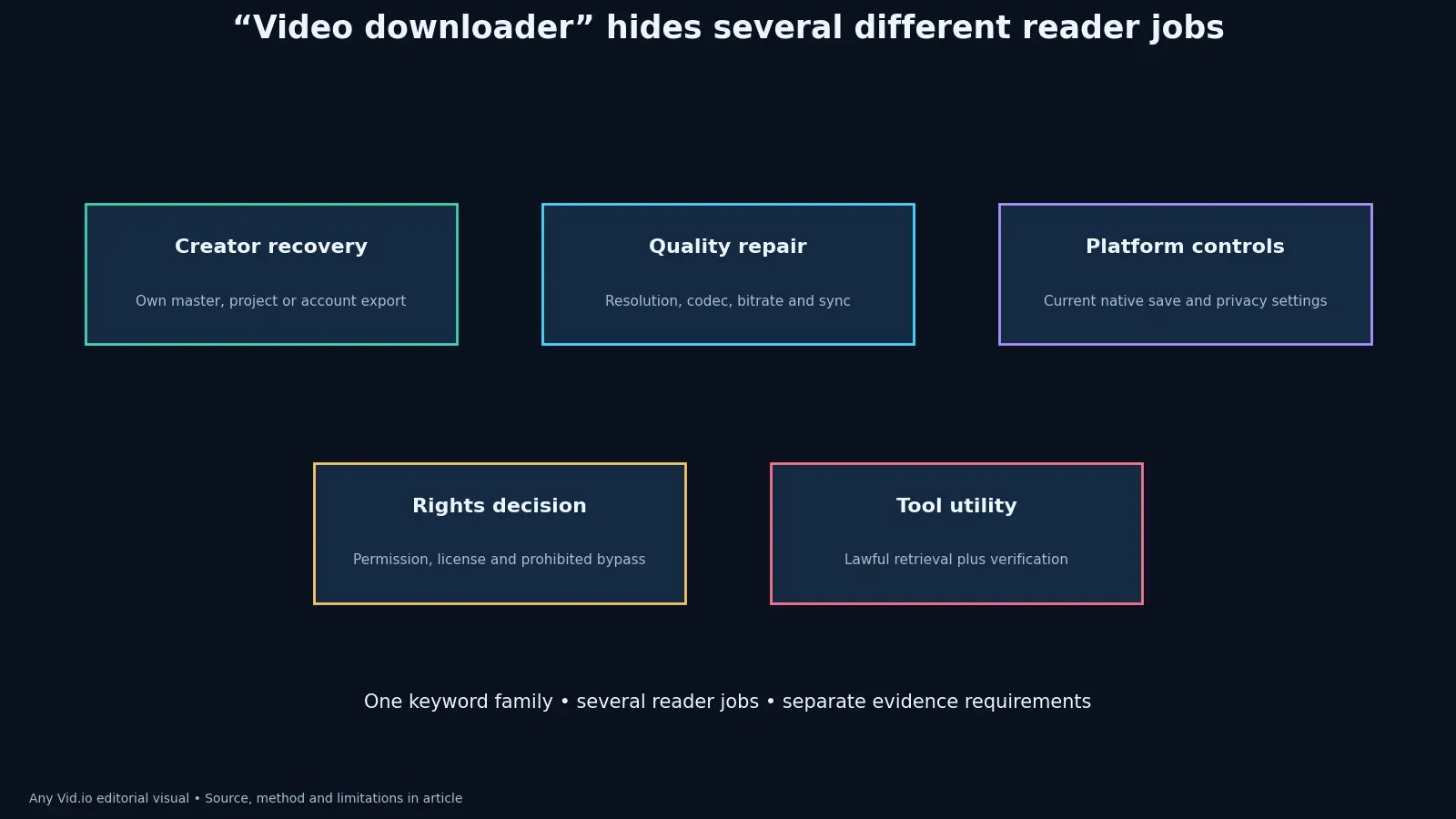
The chart is a taxonomy, not search-volume data. It separates five recurring reader jobs so titles, pages and internal links can be designed around genuine differences. The method deliberately rejects dozens of city, device, platform and “best” variants when they would repeat the same answer. SEO remains important, but it is applied after the page has a real reason to exist.
Translate the keyword into reader jobs
Classify the query as creator recovery, platform-native saving, quality troubleshooting, format conversion, archive planning, rights clarification or a prohibited access-control request. Avoid designing around a single metric.
Write the successful end state in plain language: the creator recovered an owned file, diagnosed quality loss, found an official export or learned why a requested use is inappropriate.
Use the question discipline from the searchable video tutorial guide so each page completes one task well.
A keyword-to-reader-job brief should name one searcher's problem, the proof that would answer it and the next action the page should enable. Record which existing page already handles the job. If the draft overlaps, decide whether the new evidence belongs in that page instead. A title is useful only when the body delivers its specific promise.
Reject duplicate keyword pages before drafting
Compare drafts by the decision they help a creator make. A guide to recovering your own Reel needs the official account route, the local master and a verification step; a quality diagnosis needs a source/derivative pair and measured file properties. Those can justify separate URLs. Two pages that repeat the same steps with different adjectives usually need one stronger answer, not another keyword variation.
Do not split 'best', 'free', 'online', 'fast' and 'HD' into separate pages unless each one has a genuinely different test and audience decision. A broad claim should say what was measured, on which input and under which limitations. If no bounded evidence supports the distinction, choose a precise title for the existing page and improve that page's explanation.
Before opening a new URL, apply the evergreen page refresh workflow to the relevant existing guide. Check its live platform steps, screenshots, source links and unresolved user questions. A targeted update can preserve a useful URL while answering a newly observed task; a new page is justified when the reader's goal and required evidence are materially different.
Pause here for a handoff check. Ask another person to follow the record without coaching; if publishing many near-duplicate pages that add no value beyond a tool form can still happen silently, the workflow needs a clearer owner, filename or acceptance test.
Write rights boundaries into the intent
State early that the workflow covers media the reader created, owns or has permission or another lawful right to save; do not hide the boundary below the tool.
Refuse instructions for DRM circumvention, access-control bypass or deceptive reposting and redirect the reader toward platform-native exports, permissions or licensed source delivery.
Public visibility does not confer permission to reuse, monetize or remove attribution from somebody else's media. Put that limitation beside the instruction that might otherwise be misread. For a creator's own video, distinguish an account export, a local production master and a permitted platform copy; each has a different role and may carry different quality or metadata.
Put the result in a keyword-to-reader-job content brief, attach the evidence path and date it so a later platform or software change can be compared with the same decision.
Add first-hand or reproducible value
Run a controlled encoding test, inspect a real account-data package, publish a restoration checklist or document a measured workflow rather than paraphrasing ten competitor pages.
The encoding case study shows why a named input, repeatable settings and stated limitations are more useful than an unsupported 'best quality' label. A different question may require a restoration checklist, a current platform help source or a permission decision rather than an encoding chart. Choose evidence that answers the reader's job.
Keep commands, settings, sample size and limitations beside the result so another reader can reproduce the test and see where their media differs.
Metrics such as intent coverage, evidence quality and successful task completion are useful only when they lead to a visible choice and do not conceal the limits of this sample.
Place the tool inside a complete answer
Order the page around the task: determine ownership and the best available source, explain any official platform option, inspect the resulting file and document the next storage or troubleshooting step. A utility can be offered where it legitimately helps, but it cannot replace a rights explanation or recover a source master that no longer exists. Show the limit before the call to action.
Mention AnyVid only where its lawful saving function fits the stated task. Keep the article useful if a reader chooses a native platform export or already has the master. This also makes the page easier to maintain when a supported platform changes its controls: the decision framework survives even if one button name or interface step does not.
Link technical readers to the video container and codec guide at the point where format confusion affects the task.
Use a pre-publication comparison rather than a retrospective promise. Lay the proposed page beside the closest existing article and highlight the facts, examples or decisions available only in the draft. If the difference vanishes after removing product mentions and keyword variants, revise the existing article instead of publishing a second near-duplicate.
Use links as evidence, not decoration
Place Google’s people-first guidance beside the editorial claim it informs instead of collecting sources in a footer nobody can interpret.
Link platform help pages for current controls, standards documents for technical claims and research papers for benchmark data; avoid scraped copies and affiliate roundups.
Link directly to clean primary resources when a platform or standard supports a factual claim. Treat a compensated product link differently from an editorial citation: disclose the commercial relationship and use the appropriate sponsored link attribute. Do not add external links for a target count; add the source where it clarifies a changing rule or a measured claim.
Keep uncertainty close to the relevant statement. If a platform control varies by account, region or app version, date the observation and show how the reader can check the current option. If a test used one file or device, do not describe the result as a platform-wide benchmark. The limitations help readers adapt the method rather than follow a brittle command.
Measure satisfaction, not just clicks
Use support questions and on-page failures to find unmet reader needs. A page may attract impressions for 'save video' while actually helping a creator who needs a source archive; the query and task can diverge. Compare the reader's reported problem with the page's promised outcome before changing its title or expanding its keyword coverage.
Connect watch-page and indexing work to the video sitemap guide without assuming a submitted URL or sitemap guarantees search visibility.
Review support messages and on-page failures alongside search impressions; a page can attract the right phrase while giving the wrong answer.
Keep the intent brief, primary sources and test assets with the URL's editorial record. At the next review, compare the original audience promise with current platform behavior and reader feedback. A change should be traceable to evidence, not to a new synonym discovered in a keyword tool.
Maintain a small, defensible cluster
Give every URL an owner, primary intent, factual review date, source list, internal-link role and consolidation rule.
Use the video key moments guide for pages that contain a primary tutorial video instead of sprinkling video markup on unrelated text pages.
Consider consolidation only after comparing actual reader jobs and Search Console query-to-page data. If two URLs now answer the same question with no independent evidence, plan a careful editorial merge that preserves the useful material and known links. This audit does not establish that condition, so no existing URL or redirect should be changed on the strength of title similarity alone.
Before publishing, ask three questions: who needs this exact answer, what original evidence or decision makes the page distinct, and can that reader complete the task lawfully? If any answer is vague, revise the draft or strengthen the relevant existing page. A longer article or additional FAQ cannot repair a mismatch between headline and task.
Score a downloader-intent page before publication
Take the draft title and write the five most plausible jobs a searcher could mean by it: recover my own upload, understand platform controls, preserve quality, compare lawful workflows, or save media with permission. Assign one job as primary and state which jobs the page will not solve. Now inspect every section against that contract. If a paragraph merely repeats the query or lists platforms without advancing a decision, remove it. If a safety statement is detached from the step where misuse could occur, move it into the workflow. This edit produces usefulness and risk context at the same time.
Build a source ledger with one row per changeable claim. Record the claim, primary source, access date, scope and the sentence that communicates its limitation. Platform help pages should support platform behavior; standards or tool documentation should support technical definitions; a controlled test should support only its own sample. Do not turn the absence of a statement into permission. Commercial links belong in a separate review column so rel values can be checked deliberately. A product, purchase, signup, affiliate or paid-placement destination should use sponsored and nofollow as appropriate rather than inheriting trust from editorial prose.
Finally, conduct a blind task test. Give the page to someone who matches the intended reader and ask them to complete the named job using only the article and an authorized sample file. Note where they hesitate, which link they expect near a step and what they believe the page promised. Their interpretation matters because a literally cautious sentence can still create a misleading overall impression. Correct the strongest mistaken takeaway, retest the changed section on mobile and keep the task notes as evidence for the next update rather than inventing engagement claims.
Case-study table
| Search phrase family | Likely reader job | Useful page promise | Editorial boundary |
|---|---|---|---|
| video downloader | Save a permitted file or solve a failed retrieval | Choose a lawful route and verify the resulting file | No universal platform or rights claim |
| Instagram video downloader | Recover or archive a Reel the creator owns | Compare native, account and master-file routes | Public does not mean licensed for reuse |
| TikTok video downloader | Save a creator-owned post or account record | Separate native save, data export and source archive | Respect creator download settings |
| downloaded video blurry | Diagnose a quality difference | Inspect resolution, codec, bitrate and processing generation | No “original quality” guarantee |
| AI video generator | Create or evaluate synthetic footage | Use shot planning, provenance and disclosure | No unauthorized likeness or guaranteed realism |
Use the table as an intent map rather than search-volume evidence. Each row pairs a distinct creator task with the evidence and safe next step it requires; it does not imply that any listed phrase has a measured ranking opportunity.
Put the method to work
Before approving another downloader-keyword page, ask what reader job would disappear if the URL were removed. If the answer is only “another variation might rank,” consolidate it. If the page contains a distinct test, platform process or repair workflow, make that evidence the center of the brief.
The AnyVid.io blog connects technical video SEO with creator workflows. Search optimization is useful when it helps people discover a complete answer; it does not turn thin repetition or unsafe instructions into a publishing strategy.
AnyVid.io Editorial Team
The AnyVid.io Editorial Team publishes practical guides on short-form video production, AI-assisted creator workflows, Instagram and TikTok strategy, video SEO, audience growth and creator monetization.
Frequently asked questions
Is “video downloader” a safe SEO topic for an AdSense-focused site?
It can be covered responsibly when the page has independent informational value, supports lawful creator tasks and avoids piracy, access-control bypass and deceptive claims. No article can guarantee AdSense approval; Google evaluates sites and policy compliance in context. Record the route, date and result in a keyword-to-reader-job content brief so the same question can be checked against future platform or workflow changes.
Should I create separate pages for every downloader keyword variation?
Only when the reader job, evidence and workflow are substantially different. Pages that merely swap “free,” “online,” a device name or a platform name can become thin duplicates. Consolidate overlapping intent and invest in a complete answer. For an editor planning search content around downloader-related queries, the safest next step is a reversible test with one authorized file and a written result rather than a universal assumption.
Can I mention AnyVid.io in downloader articles?
Yes, when the utility is contextually relevant, but keep the mention restrained. Explain official and source-master options, rights, quality limitations and troubleshooting first. The article should still help readers if the product reference is removed. Keep the evidence tied to intent coverage, evidence quality and successful task completion; that prevents a convenient observation from becoming a broader claim than the case study supports.
Do exact-match keywords need to appear repeatedly?
No. Use the primary phrase naturally in the title, introduction and relevant headings, then write for the reader’s task with related concepts. Repetition that harms readability does not create expertise or satisfy intent. If publishing many near-duplicate pages that add no value beyond a tool form remains possible, preserve the original state and ask for rights or technical review before changing the only surviving copy.
What original value can a downloader article add?
A reproducible quality test, source-versus-platform comparison, account-export walkthrough, rights decision table, archive manifest, troubleshooting matrix or measured storage plan can provide value competitors do not. State the method and limitations. Record the route, date and result in a keyword-to-reader-job content brief so the same question can be checked against future platform or workflow changes.
Does helpful content guarantee Google rankings or AdSense approval?
No. Google’s guidance explains qualities its systems seek to reward, but it does not promise a position or approval. Treat it as a framework for building useful, trustworthy pages and comply with all applicable publisher and product policies. For an editor planning search content around downloader-related queries, the safest next step is a reversible test with one authorized file and a written result rather than a universal assumption.
Was this article helpful?
Tell us what worked so we can improve future content.