
A talking-head clip, handheld leaves in wind and a screen recording do not compress the same way. Yet creators often export all three with one inherited bitrate preset, then blame the codec when detail smears or files become needlessly large. Content-optimized encoding research starts from the opposite premise: the useful bitrate-resolution choices depend on the material.
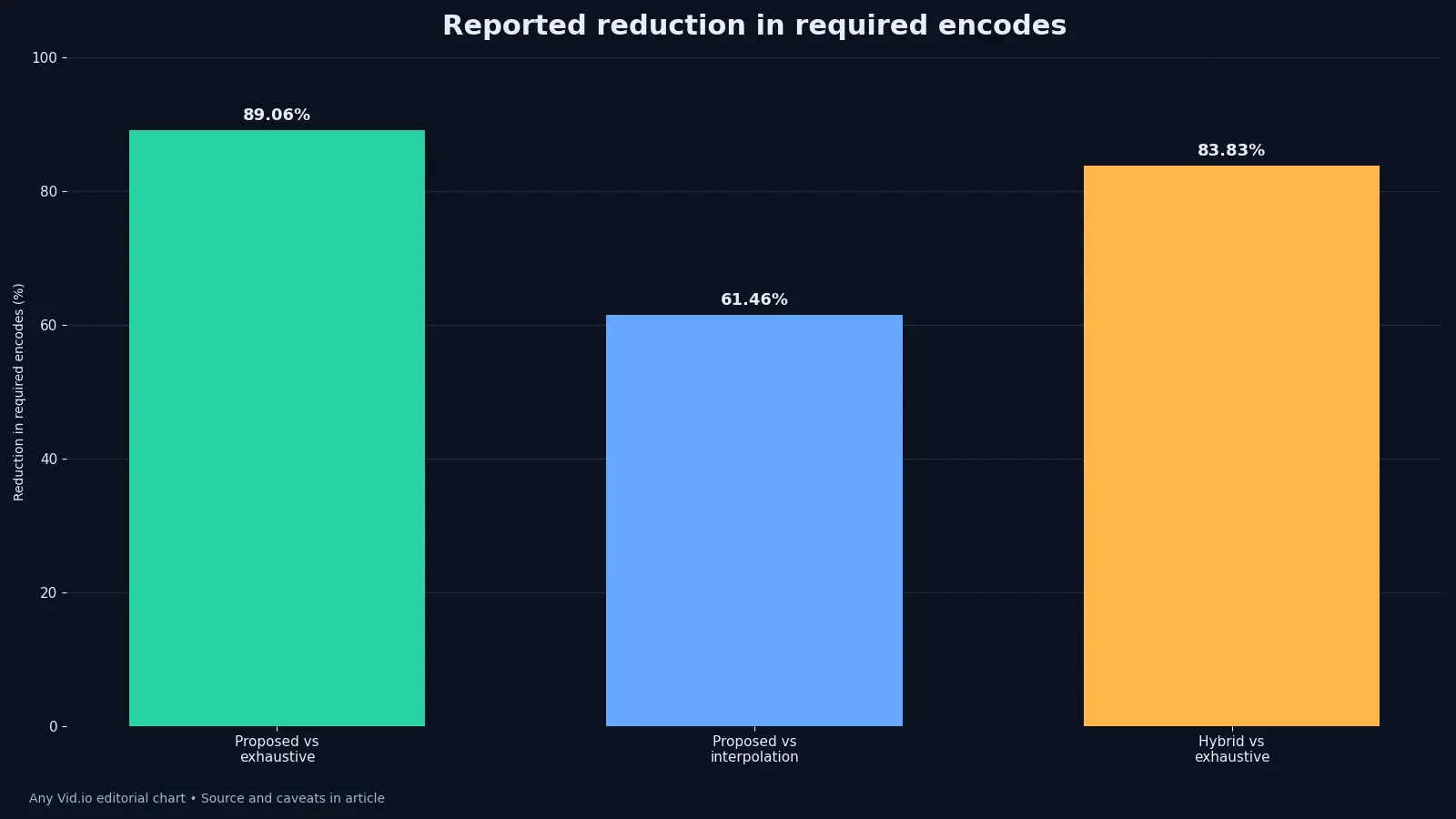
Angeliki Katsenou, Joel Sole and David Bull evaluated a machine-learning method on 100 HEVC-encoded sequences. Compared with exhaustive search, the proposed method reduced the required encodes by 89.06% at an average BD-rate difference of 1.78%. A hybrid method reduced encodes by 83.83% with an average BD-rate difference of 1.26%; against an interpolation method, the proposed approach reduced encodes by 61.46%. Those are study results, not a recipe for social uploads, but the trade-off is directly useful.
Understand the optimization problem
An exhaustive search encodes many resolution and quality combinations to find a rate-distortion frontier. The failure mode is easy to recognize: the headline number survives while the conditions disappear. Sample size, time window, content library, distribution surface and measurement definition all shape the result. Keep those conditions beside the metric in the project notes, especially when the source is a platform, vendor or company describing its own success.
The research predicts useful ladder parameters from spatiotemporal features, reducing experiments while accepting a measured difference from exhaustive results. A small creator can still use the lesson without imitating the scale. Reduce the operation to one page, one video family or one campaign. Establish the current state, change one coherent bundle of decisions, and wait long enough for the relevant behavior to occur. If several variables move together, describe the result as a package rather than crediting a favorite detail.
Creator exports usually target one or a few files, but the same content-dependence explains why fixed advice fails. Success should be visible in the work as well as the dashboard. A cleaner page should be easier to inspect; a stronger disclosure should be harder to miss; a better edit should answer the viewer sooner. When a metric rises but the audience experience becomes less accurate or less accessible, the experiment has found a trade-off, not an uncomplicated win.
Read the three reductions correctly
The 89.06% and 83.83% figures compare methods with exhaustive search, while 61.46% uses an interpolation-based comparison. Document the unsuccessful pass too. Rejected versions show which constraints mattered and stop the team from repeating an attractive mistake six weeks later. A useful record needs the date, source material, decision owner, changed element, observation window and one sentence about uncertainty. That is enough structure for learning without building a bureaucracy.
Do not add the percentages or treat them as storage savings; they refer to the number of encodes required. Treat the chart as a map of the published evidence, not a forecast. It compresses the reported values so patterns are easier to see, but it does not add precision the source never supplied. Thresholds such as ‘more than’ or ‘fewer than’ remain thresholds, and indexed pages, clicks, traffic and engagement must not be silently treated as the same outcome.
Keep the paired BD-rate differences beside the reductions because speed without quality cost is an incomplete story. Before generalizing, ask what else changed at the same time. A creator may alter cadence, subject, collaboration and presentation together; a publisher may add markup while fixing indexing; a production may combine generation with conventional editing. The honest conclusion is often that the workflow bundle worked under observed conditions, while the contribution of each part remains unknown.
Translate the principle to creator footage
High motion, fine texture, noise and fast camera movement generally stress compression more than clean static frames. The next test should be cheaper than the story that inspired it. Use existing footage, a limited archive, a single sponsor brief or a short run of posts. Decide in advance what would make you stop, continue or revise. Pre-committing to those choices reduces the temptation to explain every noisy result as proof that the idea was right.
A screen recording may punish soft text edges even when a talking face at the same bitrate looks acceptable. Finally, preserve editorial judgment. Data can expose a pattern and a case can demonstrate feasibility, but neither can decide what is responsible for your audience, sustainable for your capacity or consistent with your voice. The creator still owns that decision—and should be able to explain it without hiding behind an algorithm or a benchmark.
Build test clips from your hardest real footage rather than a convenient studio shot. The important distinction is between what the record establishes and what an editor might infer. A published outcome can show that a particular team changed a particular system; it cannot prove that copying one visible tactic will reproduce the number. Use the evidence to choose a test, then measure that test against your own baseline.
Make a small export matrix
Choose one resolution and two or three bitrate or quality settings supported by the actual delivery platform. In practice, turn that observation into a written decision before opening the camera or editor. Name the audience question, the asset that will answer it, and the signal that would justify keeping the change. This keeps a striking result from becoming a vague command to ‘do more’ and gives collaborators something concrete to challenge.
Keep codec, frame rate, color handling and audio settings fixed while testing the variable you want to understand. The failure mode is easy to recognize: the headline number survives while the conditions disappear. Sample size, time window, content library, distribution surface and measurement definition all shape the result. Keep those conditions beside the metric in the project notes, especially when the source is a platform, vendor or company describing its own success.
Name files with the settings so visual preference is not reconstructed from memory. A small creator can still use the lesson without imitating the scale. Reduce the operation to one page, one video family or one campaign. Establish the current state, change one coherent bundle of decisions, and wait long enough for the relevant behavior to occur. If several variables move together, describe the result as a package rather than crediting a favorite detail.
Inspect quality and production cost
Watch at normal speed and inspect motion, texture, gradients, text and faces on the device viewers use. Success should be visible in the work as well as the dashboard. A cleaner page should be easier to inspect; a stronger disclosure should be harder to miss; a better edit should answer the viewer sooner. When a metric rises but the audience experience becomes less accurate or less accessible, the experiment has found a trade-off, not an uncomplicated win.
Record encode time, file size and any upload processing result alongside visual notes. Document the unsuccessful pass too. Rejected versions show which constraints mattered and stop the team from repeating an attractive mistake six weeks later. A useful record needs the date, source material, decision owner, changed element, observation window and one sentence about uncertainty. That is enough structure for learning without building a bureaucracy.
Avoid relying on a single objective score when the artifact that matters is local and obvious to viewers. Treat the chart as a map of the published evidence, not a forecast. It compresses the reported values so patterns are easier to see, but it does not add precision the source never supplied. Thresholds such as ‘more than’ or ‘fewer than’ remain thresholds, and indexed pages, clicks, traffic and engagement must not be silently treated as the same outcome.
Choose a stopping rule
Stop increasing bitrate when meaningful defects no longer improve in the target playback context. Before generalizing, ask what else changed at the same time. A creator may alter cadence, subject, collaboration and presentation together; a publisher may add markup while fixing indexing; a production may combine generation with conventional editing. The honest conclusion is often that the workflow bundle worked under observed conditions, while the contribution of each part remains unknown.
Stop reducing bitrate when edges, texture, motion or audio become unacceptable for the promise of the video. The next test should be cheaper than the story that inspired it. Use existing footage, a limited archive, a single sponsor brief or a short run of posts. Decide in advance what would make you stop, continue or revise. Pre-committing to those choices reduces the temptation to explain every noisy result as proof that the idea was right.
Keep a higher-quality master even when delivery files are smaller, subject to storage and rights policies. Finally, preserve editorial judgment. Data can expose a pattern and a case can demonstrate feasibility, but neither can decide what is responsible for your audience, sustainable for your capacity or consistent with your voice. The creator still owns that decision—and should be able to explain it without hiding behind an algorithm or a benchmark.
Avoid codec-name shortcuts
A newer codec can improve efficiency but may cost encoding time, compatibility or editing smoothness. The important distinction is between what the record establishes and what an editor might infer. A published outcome can show that a particular team changed a particular system; it cannot prove that copying one visible tactic will reproduce the number. Use the evidence to choose a test, then measure that test against your own baseline.
Container and codec are different decisions; MP4 does not by itself identify the video codec inside. In practice, turn that observation into a written decision before opening the camera or editor. Name the audience question, the asset that will answer it, and the signal that would justify keeping the change. This keeps a striking result from becoming a vague command to ‘do more’ and gives collaborators something concrete to challenge.
Test the complete delivery chain instead of declaring one codec universally superior. The failure mode is easy to recognize: the headline number survives while the conditions disappear. Sample size, time window, content library, distribution surface and measurement definition all shape the result. Keep those conditions beside the metric in the project notes, especially when the source is a platform, vendor or company describing its own success.
Build a reusable export record
Save a short reference set for talking head, motion, screen text and low light. A small creator can still use the lesson without imitating the scale. Reduce the operation to one page, one video family or one campaign. Establish the current state, change one coherent bundle of decisions, and wait long enough for the relevant behavior to occur. If several variables move together, describe the result as a package rather than crediting a favorite detail.
Record software version, encoder, settings, hardware and evaluation notes. Success should be visible in the work as well as the dashboard. A cleaner page should be easier to inspect; a stronger disclosure should be harder to miss; a better edit should answer the viewer sooner. When a metric rises but the audience experience becomes less accurate or less accessible, the experiment has found a trade-off, not an uncomplicated win.
Re-test when the platform, editing application or camera pipeline changes rather than trusting an old preset forever. Document the unsuccessful pass too. Rejected versions show which constraints mattered and stop the team from repeating an attractive mistake six weeks later. A useful record needs the date, source material, decision owner, changed element, observation window and one sentence about uncertainty. That is enough structure for learning without building a bureaucracy.
Evidence table
| Method comparison | Fewer required encodes | Average BD-rate difference |
|---|---|---|
| Proposed vs exhaustive | 89.06% | 1.78% |
| Proposed vs interpolation | 61.46% | Not stated in abstract for this comparison |
| Hybrid vs exhaustive | 83.83% | 1.26% |
| Study sample | 100 HEVC sequences | Research context, not social benchmark |
This evidence table for A 100-Sequence Encoding Study and the Cost of Testing Every Export is deliberately compact. It preserves the unit and limitation beside each result so the number cannot wander into a slide deck as an unsupported universal benchmark. For a working analysis, add the date you accessed the source and the exact metric definition used in your own account.
Source and method
This case study relies on Katsenou, Sole and Bull, Efficient Bitrate Ladder Construction for Content-Optimized Adaptive Video Streaming. The chart redraws only values stated by that source or transparent transformations described in its caption. No private dashboard data, invented survey, simulated outcome or scraped personal information is presented as fact.
For this Video Production analysis, any interest held by a platform or company reporting its own result is named; academic designs and dates remain visible. The source link lets readers inspect the original wording, while current feature or legal questions should still be checked against current primary guidance before action.
Apply the case without copying it
Choose one bounded project and write a baseline before making changes. Preserve the case’s logic—clear variables, visible evidence and honest limitations—without imitating its scale or headline outcome. Read MP4, WebM, MOV and Codecs: A Creator’s Export Decision Guide. Read Fix Hollow Voice Audio in an Untreated Room. Read Shoot B-Roll Alone With a Six-Shot Coverage System.
Review the Video Production result with the people who make and use the content. Keep what improves clarity, trust or sustainable production; revise what merely chases the published number. Browse the AnyVid.io blog for more creator workflows. When archiving reference media, use only media you created, own, or have permission or another lawful right to save.
Frequently asked questions
Do the reported percentages mean my exports will be 89% smaller?
No. They describe a reduction in the number of encodes required by the study method compared with exhaustive search. They are not file-size, bitrate, upload-time or storage savings for a creator workflow.
What is BD-rate?
Bjøntegaard delta rate is a way to compare rate-distortion curves across a quality range. Interpretation depends on the metric and setup. For everyday creator tests, pair file size and encode time with careful viewing of the actual defects that matter.
Should creators use HEVC for every export?
No. HEVC can be efficient, but compatibility, editing performance, licensing context and platform processing matter. Use the delivery service’s current guidance and keep a high-quality master in a format your workflow can reliably open.
How many test exports are practical?
For one target, two or three carefully chosen variants often reveal more than a huge uncontrolled matrix. Hold other settings steady, use demanding real footage and stop when additional bitrate no longer creates a meaningful viewing improvement.
Why keep a master file?
Delivery services may recompress uploads, and future platforms or edits may need a different derivative. A well-managed high-quality master prevents repeated generation loss. Store only media you own or have permission or another lawful right to retain.
Was this article helpful?
Tell us what worked so we can improve future content.