
Washed-out HDR is rarely one bad saturation slider. It is usually a disagreement between stages: the camera records one transfer function, the editor interprets another, the export carries incomplete tags, the platform creates derivatives, and the viewer’s device chooses an SDR or HDR path. Correcting the final frame without finding the mismatch can make the next device look worse.
YouTube’s HDR upload guidance documents supported color metadata and notes that HDR processing can take longer; current details should be checked before delivery. Apple’s HDR media support guidance likewise reflects a device and software ecosystem that changes over time. This guide uses those sources as checkpoints, not as a promise that every editor, platform or display behaves identically.
Identify the actual failure
Compare the camera original, editor viewer, local export, uploaded HDR playback and uploaded SDR playback separately. When a source is a platform or vendor describing its own ecosystem, use the information without borrowing the sales conclusion. Preserve the sample and method, compare it with your own evidence, and link to the original so readers can inspect the context. Citation is not endorsement. If collaborators are involved, agree on the metric definition and approval standard before work begins. Editors, clients and creators often use the same word for different outcomes. One written example prevents a later argument about what ‘engagement,’ ‘usable’ or ‘approved’ meant.
Write down the device, operating system, browser or app, display mode and whether HDR playback was actually active. Build an exit ramp before the test begins. State the safety, rights, workload or audience signal that would stop publication. Clear stopping rules help a team move quickly because they replace last-minute bargaining with decisions already connected to the brief. Review the work at normal speed before frame-by-frame inspection. Severe artifacts deserve technical attention, but a microscopic flaw that no viewer can perceive should not automatically outrank story clarity, accessibility, consent or the promised practical result.
A single washed-out preview may be a non-color-managed viewer rather than a broken master. The final artifact should be reusable. Save the approved language, measurement definition, visual reference and result beside the project—not only the finished file. Future work improves when the reasoning survives after the timeline and chat messages disappear. Preserve the version that served as the baseline. Without it, improvement becomes a story told by the newest file. A side-by-side comparison also helps the team avoid fixing one visible weakness by quietly introducing a different problem elsewhere.
Confirm capture and project space
Identify the recorded transfer function, primaries, bit depth and any camera profile instead of guessing from a vivid phone display. Accessibility belongs in the production logic, not the last export pass. Captions, legible graphics, spoken context and controlled motion affect who can use the work and how confidently they can follow it. Include those checks before judging retention or conversion. When the outcome is mixed, resist averaging incompatible signals into a single score. State what improved, what worsened and what stayed unknown. A qualified decision is more actionable than a composite number whose weighting nobody can defend.
Set the project’s working and output color management deliberately; automatic detection can be useful but must be verified. Finally, communicate the limitation where the claim appears. A footnote at the bottom cannot fully repair an exaggerated headline, and a disclaimer cannot rescue an inaccurate promise. Precise language is part of the strategy because it attracts the audience the content can genuinely serve. Consider the people excluded by the measurement. Silent viewers, people using captions, subscribers arriving later and clients judging deliverables may matter even when the dashboard centers immediate public reactions. Add a qualitative check for the audience the metric cannot describe.
Keep container and codec separate using the creator export decision guide because an MP4 extension does not describe the color pipeline. That sounds simple, but it changes the working question. Instead of asking whether the post was ‘good,’ the review asks which promise was made, what evidence the viewer received, and where the result departed from the plan. A useful note names the next decision; a vague verdict merely preserves the team’s mood. Finally, date the recommendation. Platform controls, pricing, support and technical requirements change, while the article’s underlying decision method should remain useful. A visible access date makes later verification routine instead of treating old operational details as permanent facts.
Inspect scopes, not visual memory
Use waveform and RGB parade views to locate clipped highlights, raised blacks and channel imbalance. The common mistake is to preserve the number while dropping its denominator and conditions. A percentage, rate or multiplier only makes sense beside the sample, time window, content type and source. Keep those details in the same row of the worksheet so a later presentation cannot quietly turn a bounded finding into universal advice. For the working review, capture one screenshot or export from the relevant stage, write the exact setting or audience condition, and compare it with the planned result. Evidence that can be revisited is more reliable than a confident recollection after publication.
Compare a known reference and inspect critical skin, product and brand colors under controlled viewing conditions. A solo creator can make the method smaller without making it sloppy. Use one content family, one delivery surface and a short observation window. Change a coherent variable, capture the result, and write down what else moved. The discipline matters more than the size of the dashboard. Ask a second person to follow the instruction without verbal coaching. Note the point where they hesitate, the assumption they make, and the proof that resolves it. Those observations often reveal a better edit than another round of generalized polishing.
Do not force every highlight below SDR levels when the delivery is genuinely HDR, and do not assume the brightest display is the most accurate. Success has to be visible outside analytics. The piece should answer the promised question more clearly, take less fragile labor, create a better conversation or lead to an appropriate business action. If the metric rises while trust or accuracy falls, the experiment has exposed a trade-off rather than a win. Set the review date while the decision is still emotionally neutral. Early checking rewards noise; indefinite checking encourages selective memory. A fixed window gives comparable work the same opportunity and makes exceptions visible when outside events genuinely require them.
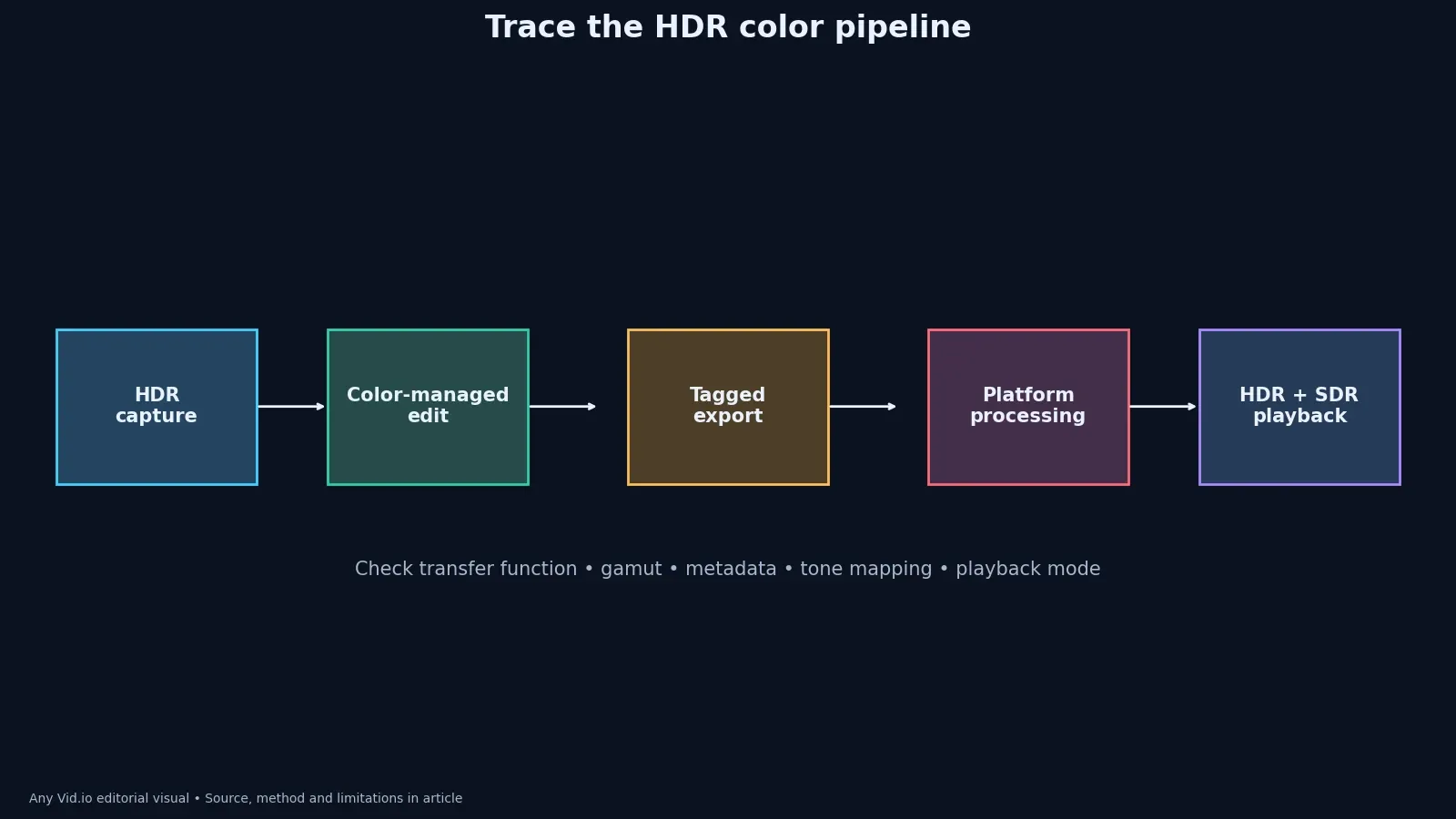
Export with consistent tags
Follow current YouTube HDR specifications for the intended upload, including supported metadata and codec details. Treat the visual in this article as an aid to reasoning, not a forecast. It either redraws numbers published by the named source or carries an explicit illustrative label. The chart does not create precision, causality or platform-wide guidance that the underlying material never supplied. Write the alternative explanation beside the preferred one. If both fit the observation, the result is not yet diagnostic. The next version should separate them with a different shot, audience segment, delivery check or deliberately held-constant production choice.
Confirm that export tags describe the actual graded signal; mislabeled SDR as HDR can look as wrong as untagged HDR. Before copying the tactic, ask what else happened at the same time. Topic demand, audience composition, creative quality, distribution, seasonality and collaboration can all move together. An honest review often concludes that a bundle worked under specific conditions while the contribution of each component remains uncertain. Keep raw counts where the interface permits and describe any missing fields. Rates are easier to compare, but counts expose tiny samples and sudden distribution changes. Never reconstruct a denominator from rounded percentages when the platform does not provide it.
Preserve a tested master and use the content-aware export test to compare delivery settings without altering several variables at once. Make the next test cheaper than the claim that inspired it. Reuse lawful source material, limit the number of variants, and define what would make you continue, revise or stop. A small test protects time and reputation while still producing information that can improve the next brief. Turn the lesson into a checklist item that appears before the next irreversible step. Advice stored only in a retrospective is easy to admire and easy to ignore. Placement in the workflow is what converts analysis into a repeatable safeguard.
Test the SDR fallback
Many viewers will encounter an SDR display, disabled HDR mode or a platform-generated SDR derivative. Look for the failure at the handoff. A sound idea can be weakened when the script becomes a shot list, when the shot becomes an edit, or when the export reaches a platform. Naming the handoff makes troubleshooting faster because the team tests one boundary instead of rebuilding the entire piece. If collaborators are involved, agree on the metric definition and approval standard before work begins. Editors, clients and creators often use the same word for different outcomes. One written example prevents a later argument about what ‘engagement,’ ‘usable’ or ‘approved’ meant.
Review tone mapping for highlight roll-off, contrast and saturation rather than trusting a default conversion blindly. Compare like with like. A tutorial, reaction, product demonstration and narrative scene ask different things of a viewer, so one universal target is rarely useful. Build a local comparison group with similar intent and duration, then keep the exceptions visible rather than averaging them away. Review the work at normal speed before frame-by-frame inspection. Severe artifacts deserve technical attention, but a microscopic flaw that no viewer can perceive should not automatically outrank story clarity, accessibility, consent or the promised practical result.
Choose a representative challenging scene and keep it in a reusable device test matrix. The audience should not have to reverse-engineer the premise. Use concrete nouns, observable actions and an early indication of the payoff. That does not require frantic editing; it requires alignment between packaging and what the video actually delivers. Preserve the version that served as the baseline. Without it, improvement becomes a story told by the newest file. A side-by-side comparison also helps the team avoid fixing one visible weakness by quietly introducing a different problem elsewhere.
Troubleshoot by symptom
Gray, low-contrast output suggests a transfer-function or tone-map mismatch; neon saturation can indicate incorrect gamut interpretation. Avoid solving uncertainty with extra volume. More versions, more posts or more links can create the appearance of effort while making attribution harder. Add another variable only when the current test has answered the question it was designed to answer. When the outcome is mixed, resist averaging incompatible signals into a single score. State what improved, what worsened and what stayed unknown. A qualified decision is more actionable than a composite number whose weighting nobody can defend.
Clipped bright areas may originate in capture, grade, export or display mapping, so inspect the earliest stage where detail disappears. A useful review includes one sentence beginning ‘we still do not know.’ That sentence keeps observation separate from explanation. It also creates a clean opening for the next experiment instead of inviting a confident story built from incomplete evidence. Consider the people excluded by the measurement. Silent viewers, people using captions, subscribers arriving later and clients judging deliverables may matter even when the dashboard centers immediate public reactions. Add a qualitative check for the audience the metric cannot describe.
When audio and picture problems appear together, use the separate audio troubleshooting guide rather than treating color settings as a universal export fix. Quality control should happen on the device and in the context where the audience encounters the work. Studio monitors, editing previews and internal terminology can hide ordinary viewing problems. Watch the delivered result, read the surrounding copy, and verify the action a real viewer can take. Finally, date the recommendation. Platform controls, pricing, support and technical requirements change, while the article’s underlying decision method should remain useful. A visible access date makes later verification routine instead of treating old operational details as permanent facts.
Working table
| Symptom | Probable cause | First controlled check |
|---|---|---|
| Flat and gray | HDR signal interpreted as SDR or wrong transfer function | Compare tagged master in a known color-managed player |
| Over-saturated color | Wide gamut interpreted incorrectly | Verify input, timeline and output gamut settings |
| Clipped highlights | Capture clipping or failed tone mapping | Inspect camera original and graded waveform |
| Looks right locally, wrong after upload | Tags, platform processing or playback path | Wait for HDR processing, then test HDR and SDR devices |
| Only one device looks wrong | Display mode, app or OS color management | Repeat on another known-supported playback path |
Use this table as the decision record for Why HDR Video Looks Washed Out After Upload: A Color Pipeline Fix rather than as decoration. Replace illustrative values with dated first-party observations, keep definitions beside each result, and preserve the source whenever a published figure informs the plan. The strongest row is the one that changes what the team will do next.
Put the method to work
Fix the earliest point where the image departs from the intended signal. If the camera original is sound, move one stage forward; if the local tagged master is sound, test platform processing and playback. A pipeline check is faster and safer than grading blindly against one faulty preview.
Browse additional export and production troubleshooting on the AnyVid.io blog. Archive the tested master and reference clips only when you created them, own them, or have permission or another lawful right to retain them.
Frequently asked questions
Why does HDR look washed out in some players?
A player or display may interpret the HDR transfer function as SDR, ignore metadata or apply an unsuitable tone map. Compare the same tagged file in a known color-managed environment before changing the grade.
Should I increase saturation to fix washed-out HDR?
Not first. Extra saturation can hide one preview problem while creating inaccurate color elsewhere. Verify capture interpretation, timeline space, output tags and SDR tone mapping, then adjust the grade only when the signal is being interpreted correctly.
How long does HDR processing take after upload?
Processing time varies with duration, resolution, codec and platform load. YouTube notes that HDR versions can take longer. Do not judge the final result while only an early SDR derivative is available; check current platform guidance and processing status.
Do all viewers see HDR?
No. Playback depends on the uploaded file, platform derivative, app, operating system, device, display capability and user settings. Test an intentional SDR path as well as a known HDR path.
Can I fix HDR by changing the file extension?
No. A container extension such as MP4 or MOV does not repair incorrect color interpretation. The codec, bit depth, primaries, transfer function, matrix, metadata and actual graded signal must agree across the pipeline.
Was this article helpful?
Tell us what worked so we can improve future content.