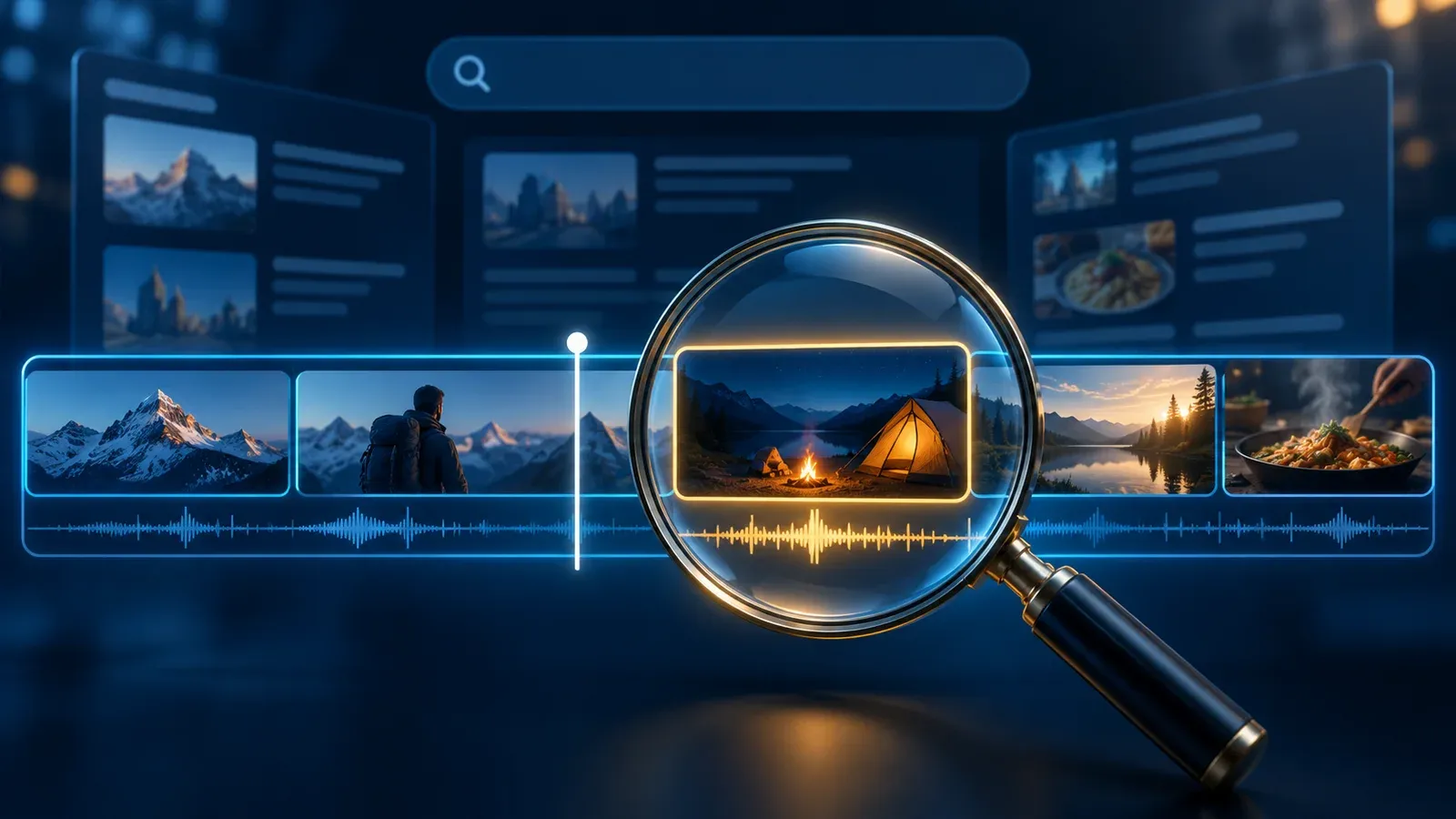
Key moments are the search-result equivalent of useful chapters: they can help someone jump to the part of a video that answers a specific need. The editorial job comes first. A chapter called ‘Step two’ is technically short but semantically weak; ‘Balance dialogue against music’ tells a searcher and a viewer what they will actually find.
Google’s VideoObject documentation says Search may detect moments automatically and can prioritize moments supplied through structured data or a YouTube description. For embedded or self-hosted video, Google documents Clip and SeekToAction approaches. Eligibility is never guaranteed, and structured data cannot rescue a thin watch page or an inaccessible video.
Choose the right video page
Begin with a page where video is the main content; the publisher video SEO case studies show why implementation and page purpose have to move together. Treat the visual in this article as an aid to reasoning, not a forecast. It either redraws numbers published by the named source or carries an explicit illustrative label. The chart does not create precision, causality or platform-wide guidance that the underlying material never supplied. If collaborators are involved, agree on the metric definition and approval standard before work begins. Editors, clients and creators often use the same word for different outcomes. One written example prevents a later argument about what ‘engagement,’ ‘usable’ or ‘approved’ meant.
Give the page a unique title, explanatory copy, stable thumbnail and a playable video that the crawler can access. Before copying the tactic, ask what else happened at the same time. Topic demand, audience composition, creative quality, distribution, seasonality and collaboration can all move together. An honest review often concludes that a bundle worked under specific conditions while the contribution of each component remains uncertain. Review the work at normal speed before frame-by-frame inspection. Severe artifacts deserve technical attention, but a microscopic flaw that no viewer can perceive should not automatically outrank story clarity, accessibility, consent or the promised practical result.
Do not create dozens of near-empty pages merely to manufacture chapter URLs. Make the next test cheaper than the claim that inspired it. Reuse lawful source material, limit the number of variants, and define what would make you continue, revise or stop. A small test protects time and reputation while still producing information that can improve the next brief. Preserve the version that served as the baseline. Without it, improvement becomes a story told by the newest file. A side-by-side comparison also helps the team avoid fixing one visible weakness by quietly introducing a different problem elsewhere.
Write human-first chapters
Mark genuine transitions where the viewer’s task, question or example changes. Look for the failure at the handoff. A sound idea can be weakened when the script becomes a shot list, when the shot becomes an edit, or when the export reaches a platform. Naming the handoff makes troubleshooting faster because the team tests one boundary instead of rebuilding the entire piece. When the outcome is mixed, resist averaging incompatible signals into a single score. State what improved, what worsened and what stayed unknown. A qualified decision is more actionable than a composite number whose weighting nobody can defend.
Use concise labels that name the answer rather than teasing it, and avoid repeating the video title in every label. Compare like with like. A tutorial, reaction, product demonstration and narrative scene ask different things of a viewer, so one universal target is rarely useful. Build a local comparison group with similar intent and duration, then keep the exceptions visible rather than averaging them away. Consider the people excluded by the measurement. Silent viewers, people using captions, subscribers arriving later and clients judging deliverables may matter even when the dashboard centers immediate public reactions. Add a qualitative check for the audience the metric cannot describe.
A strong searchable tutorial starts with the planning method in the searchable video guide, then carries that clarity into the timeline. The audience should not have to reverse-engineer the premise. Use concrete nouns, observable actions and an early indication of the payoff. That does not require frantic editing; it requires alignment between packaging and what the video actually delivers. Finally, date the recommendation. Platform controls, pricing, support and technical requirements change, while the article’s underlying decision method should remain useful. A visible access date makes later verification routine instead of treating old operational details as permanent facts.
Choose YouTube, Clip or SeekToAction
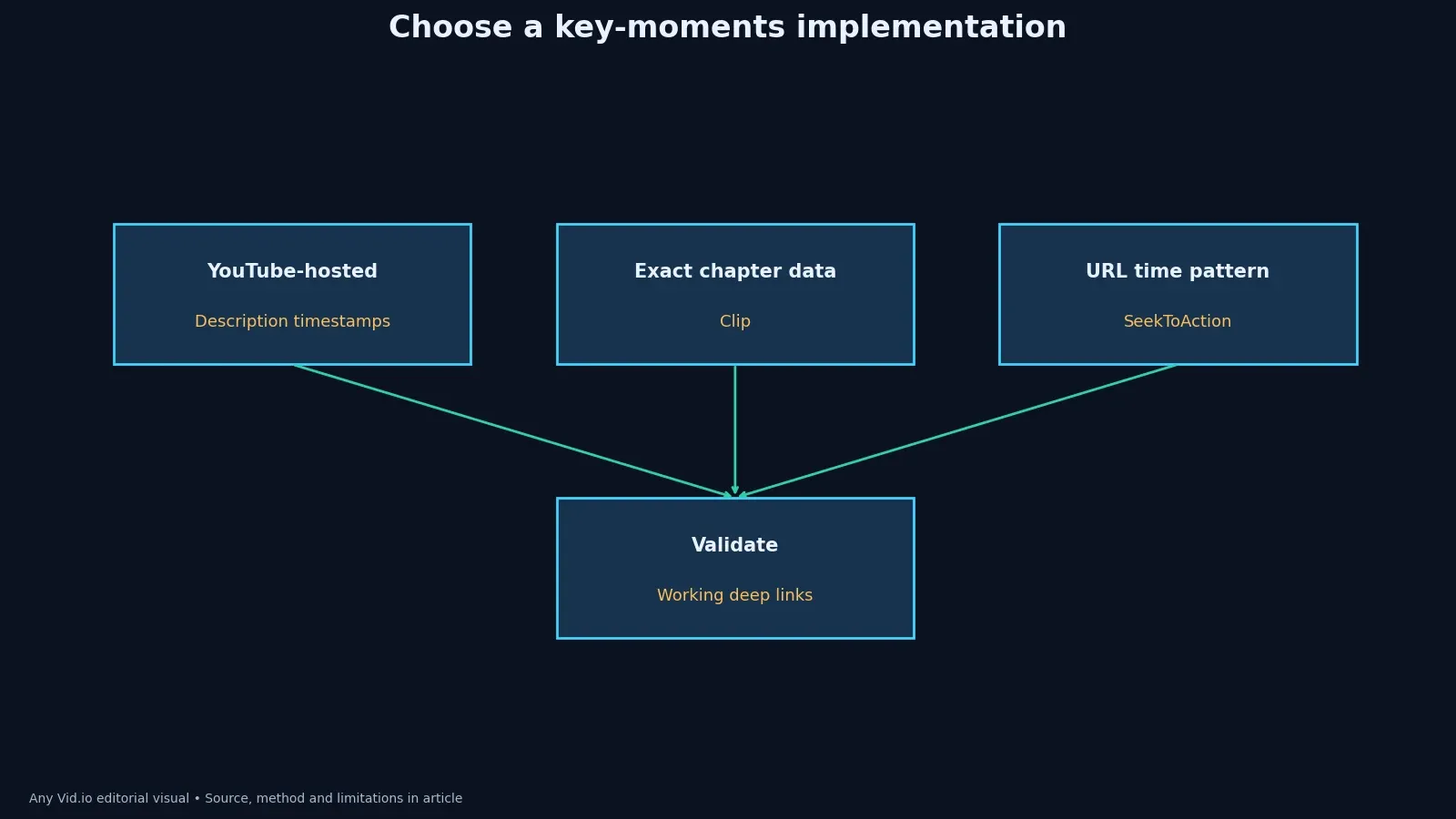
For YouTube-hosted video, descriptive timestamps in the video description can identify exact moments when they follow current platform guidelines. Avoid solving uncertainty with extra volume. More versions, more posts or more links can create the appearance of effort while making attribution harder. Add another variable only when the current test has answered the question it was designed to answer. For the working review, capture one screenshot or export from the relevant stage, write the exact setting or audience condition, and compare it with the planned result. Evidence that can be revisited is more reliable than a confident recollection after publication.
Clip specifies named start and end offsets for each important segment and works when the publisher controls exact chapter data. A useful review includes one sentence beginning ‘we still do not know.’ That sentence keeps observation separate from explanation. It also creates a clean opening for the next experiment instead of inviting a confident story built from incomplete evidence. Ask a second person to follow the instruction without verbal coaching. Note the point where they hesitate, the assumption they make, and the proof that resolves it. Those observations often reveal a better edit than another round of generalized polishing.
SeekToAction describes a URL pattern so Google can identify moments, but the video must support deep links and the documented language and duration conditions matter. Quality control should happen on the device and in the context where the audience encounters the work. Studio monitors, editing previews and internal terminology can hide ordinary viewing problems. Watch the delivered result, read the surrounding copy, and verify the action a real viewer can take. Set the review date while the decision is still emotionally neutral. Early checking rewards noise; indefinite checking encourages selective memory. A fixed window gives comparable work the same opportunity and makes exceptions visible when outside events genuinely require them.
Implement and validate
Test the deployed markup with Google’s Rich Results Test and fix critical errors before requesting indexing. When a source is a platform or vendor describing its own ecosystem, use the information without borrowing the sales conclusion. Preserve the sample and method, compare it with your own evidence, and link to the original so readers can inspect the context. Citation is not endorsement. Write the alternative explanation beside the preferred one. If both fit the observation, the result is not yet diagnostic. The next version should separate them with a different shot, audience segment, delivery check or deliberately held-constant production choice.
Confirm that every moment URL opens the same public watch page at the intended time and that robots rules or login walls do not block access. Build an exit ramp before the test begins. State the safety, rights, workload or audience signal that would stop publication. Clear stopping rules help a team move quickly because they replace last-minute bargaining with decisions already connected to the brief. Keep raw counts where the interface permits and describe any missing fields. Rates are easier to compare, but counts expose tiny samples and sudden distribution changes. Never reconstruct a denominator from rounded percentages when the platform does not provide it.
Inspect rendered source and production templates; a valid staging example does not prove the live CMS emitted the same fields. The final artifact should be reusable. Save the approved language, measurement definition, visual reference and result beside the project—not only the finished file. Future work improves when the reasoning survives after the timeline and chat messages disappear. Turn the lesson into a checklist item that appears before the next irreversible step. Advice stored only in a retrospective is easy to admire and easy to ignore. Placement in the workflow is what converts analysis into a repeatable safeguard.
Measure the user experience
Test chapters with readers who did not help make the video and ask them to find a specific answer. Accessibility belongs in the production logic, not the last export pass. Captions, legible graphics, spoken context and controlled motion affect who can use the work and how confidently they can follow it. Include those checks before judging retention or conversion. If collaborators are involved, agree on the metric definition and approval standard before work begins. Editors, clients and creators often use the same word for different outcomes. One written example prevents a later argument about what ‘engagement,’ ‘usable’ or ‘approved’ meant.
Track search impressions and clicks where available, but also inspect whether moment labels match the landing position and surrounding narration. Finally, communicate the limitation where the claim appears. A footnote at the bottom cannot fully repair an exaggerated headline, and a disclaimer cannot rescue an inaccurate promise. Precise language is part of the strategy because it attracts the audience the content can genuinely serve. Review the work at normal speed before frame-by-frame inspection. Severe artifacts deserve technical attention, but a microscopic flaw that no viewer can perceive should not automatically outrank story clarity, accessibility, consent or the promised practical result.
A useful chapter system can improve navigation even when a special search treatment never appears. That sounds simple, but it changes the working question. Instead of asking whether the post was ‘good,’ the review asks which promise was made, what evidence the viewer received, and where the result departed from the plan. A useful note names the next decision; a vague verdict merely preserves the team’s mood. Preserve the version that served as the baseline. Without it, improvement becomes a story told by the newest file. A side-by-side comparison also helps the team avoid fixing one visible weakness by quietly introducing a different problem elsewhere.
Maintain the chapter record
When refreshing a page, follow the preservation logic in the evergreen video refresh workflow so working URLs and intent are not casually broken. The common mistake is to preserve the number while dropping its denominator and conditions. A percentage, rate or multiplier only makes sense beside the sample, time window, content type and source. Keep those details in the same row of the worksheet so a later presentation cannot quietly turn a bounded finding into universal advice. When the outcome is mixed, resist averaging incompatible signals into a single score. State what improved, what worsened and what stayed unknown. A qualified decision is more actionable than a composite number whose weighting nobody can defend.
Update offsets after replacing or re-editing the media, and remove moments that no longer land on the described segment. A solo creator can make the method smaller without making it sloppy. Use one content family, one delivery surface and a short observation window. Change a coherent variable, capture the result, and write down what else moved. The discipline matters more than the size of the dashboard. Consider the people excluded by the measurement. Silent viewers, people using captions, subscribers arriving later and clients judging deliverables may matter even when the dashboard centers immediate public reactions. Add a qualitative check for the audience the metric cannot describe.
Revalidate after template, player or CDN changes because deep linking can fail outside the markup itself. Success has to be visible outside analytics. The piece should answer the promised question more clearly, take less fragile labor, create a better conversation or lead to an appropriate business action. If the metric rises while trust or accuracy falls, the experiment has exposed a trade-off rather than a win. Finally, date the recommendation. Platform controls, pricing, support and technical requirements change, while the article’s underlying decision method should remain useful. A visible access date makes later verification routine instead of treating old operational details as permanent facts.
Working table
| Method | Best fit | Critical limitation |
|---|---|---|
| YouTube description timestamps | Videos hosted on YouTube | Must follow current chapter guidance; appearance is not guaranteed |
| Clip structured data | Publisher knows exact start and end offsets | Every clip needs a useful name and working URL |
| SeekToAction | Player supports a consistent timestamp URL pattern | Requires deep linking and documented eligibility conditions |
| Automatic detection | No supplied moments | Publisher has less control over labels and chosen segments |
Use this table as the decision record for Video Key Moments SEO: Build Chapters Google Can Understand rather than as decoration. Replace illustrative values with dated first-party observations, keep definitions beside each result, and preserve the source whenever a published figure informs the plan. The strongest row is the one that changes what the team will do next.
Put the method to work
Implement key moments on one strong watch page before changing an entire library. Ask a person unfamiliar with the video to find a named answer, validate the markup, and confirm the deep link on production. That small release will reveal whether the editorial labels and technical route agree.
Continue with the technical publishing guides on the AnyVid.io blog. Special search features remain at Google’s discretion, so judge the work by accurate navigation and a useful page—not by a promised rich-result appearance.
Frequently asked questions
Do key moments improve rankings?
Google documents key moments as a search feature that can help users navigate video segments. It does not guarantee rankings, traffic or display. Treat chapters as a user-experience improvement first, then monitor search appearance without promising a result.
Should every video use Clip structured data?
No. YouTube-hosted videos may use description timestamps, while a self-hosted player with a consistent deep-link pattern may suit SeekToAction. Choose the method your publishing system can maintain accurately.
How many key moments should a video have?
Use enough to represent genuine, useful sections without splitting every sentence. Google’s technical requirements and examples should be checked for current details, but editorially each label should help someone find a distinct answer.
Why does valid markup not appear in Search?
Validation only shows that the tested code meets detectable requirements. Google still decides whether a feature is eligible and useful, and the page must be crawlable, indexed, high quality and supported by a working video experience.
What happens when the video is re-edited?
Chapter offsets can become wrong. Keep a chapter record with the master edit, update every affected timestamp and structured-data entry, test the deep links, and request recrawling where appropriate.
Was this article helpful?
Tell us what worked so we can improve future content.