A video sitemap can help a search engine discover video information that ordinary crawling might miss. It cannot turn a thin page into a useful watch page, repair a blocked thumbnail, or guarantee a video result. That distinction matters because creators often submit a technically valid file and then wait for a ranking change the file was never designed to promise.
Google’s video sitemap documentation lists the required fields and access rules, while its broader video SEO guidance emphasizes indexable watch pages where video is the main content. This guide connects the two: page purpose first, stable and crawlable media resources second, accurate sitemap entries third, and diagnosis after submission.
Start with a real watch page
Give each important video a dedicated, indexable page whose main purpose is watching and understanding that video. A generic listing page with dozens of equal tiles is a weak substitute. Record the rejected version too. Failed openings, unusable generations and broken exports reveal constraints that a polished final cut hides. A compact log—date, source, change, owner, result and uncertainty—is enough to prevent the same attractive mistake from returning in the next production cycle. Keep raw counts where the interface permits and describe any missing fields. Rates are easier to compare, but counts expose tiny samples and sudden distribution changes. Never reconstruct a denominator from rounded percentages when the platform does not provide it.
Place a descriptive title, useful supporting copy, accessible transcript or summary, and the playable video where a visitor can find it without hunting. Treat the visual in this article as an aid to reasoning, not a forecast. It either redraws numbers published by the named source or carries an explicit illustrative label. The chart does not create precision, causality or platform-wide guidance that the underlying material never supplied. Turn the lesson into a checklist item that appears before the next irreversible step. Advice stored only in a retrospective is easy to admire and easy to ignore. Placement in the workflow is what converts analysis into a repeatable safeguard.
Use the searchable tutorial filming guide to align spoken structure with the question the watch page promises to answer. Before copying the tactic, ask what else happened at the same time. Topic demand, audience composition, creative quality, distribution, seasonality and collaboration can all move together. An honest review often concludes that a bundle worked under specific conditions while the contribution of each component remains uncertain. If collaborators are involved, agree on the metric definition and approval standard before work begins. Editors, clients and creators often use the same word for different outcomes. One written example prevents a later argument about what ‘engagement,’ ‘usable’ or ‘approved’ meant.
Map the required sitemap fields
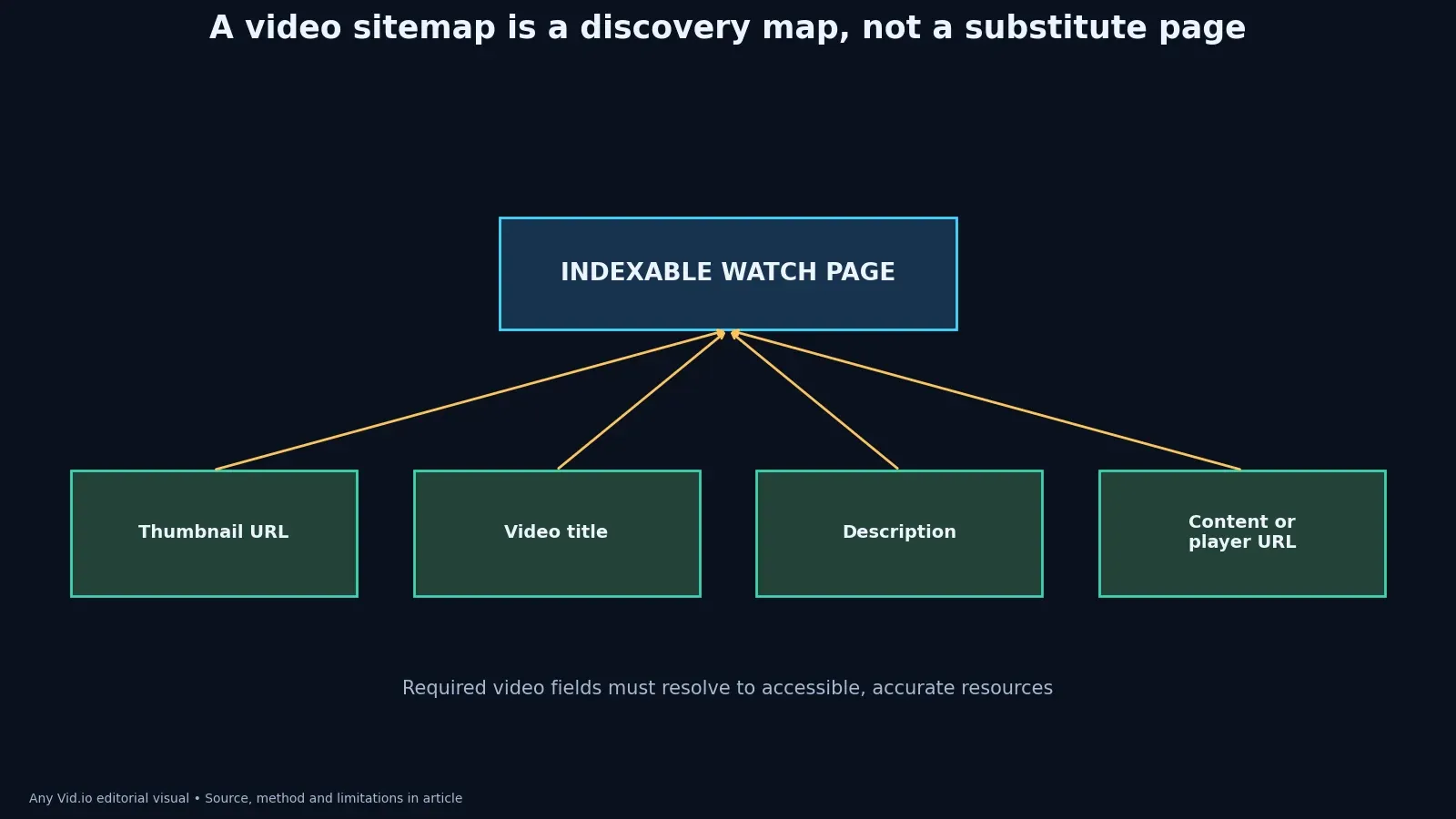
For each video entry, supply a thumbnail location, title, description and either a content location or player location as the official specification requires. Editorial judgment remains the final control. Data can reveal a pattern and documentation can reduce ambiguity, but neither decides what suits the creator’s voice, capacity or duty to the audience. Someone should be able to explain the decision in plain language without invoking a mysterious algorithm. Review the work at normal speed before frame-by-frame inspection. Severe artifacts deserve technical attention, but a microscopic flaw that no viewer can perceive should not automatically outrank story clarity, accessibility, consent or the promised practical result.
Make titles and descriptions accurate and specific to the video. Duplicating one vague phrase across a library makes both human review and technical debugging harder. Look for the failure at the handoff. A sound idea can be weakened when the script becomes a shot list, when the shot becomes an edit, or when the export reaches a platform. Naming the handoff makes troubleshooting faster because the team tests one boundary instead of rebuilding the entire piece. Preserve the version that served as the baseline. Without it, improvement becomes a story told by the newest file. A side-by-side comparison also helps the team avoid fixing one visible weakness by quietly introducing a different problem elsewhere.
Keep the page URL, thumbnail URL and video or player URL stable. Frequent opaque changes create rediscovery work and break evidence gathered during diagnosis. Compare like with like. A tutorial, reaction, product demonstration and narrative scene ask different things of a viewer, so one universal target is rarely useful. Build a local comparison group with similar intent and duration, then keep the exceptions visible rather than averaging them away. When the outcome is mixed, resist averaging incompatible signals into a single score. State what improved, what worsened and what stayed unknown. A qualified decision is more actionable than a composite number whose weighting nobody can defend.
Keep resources crawlable
Test every referenced resource without a logged-in session. A sitemap can name a URL perfectly while authentication, robots rules or expiring signatures prevent retrieval. Operationally, assign this decision a home. It might live in the storyboard, rights log, offer sheet, export checklist or analytics review, but it should not depend on memory. The best systems make the responsible action easier at the moment pressure is highest. Consider the people excluded by the measurement. Silent viewers, people using captions, subscribers arriving later and clients judging deliverables may matter even when the dashboard centers immediate public reactions. Add a qualitative check for the audience the metric cannot describe.
Serve a representative thumbnail at a stable URL and verify its status code and content type. A design system image that changes under the same URL can complicate cache and quality review. Avoid solving uncertainty with extra volume. More versions, more posts or more links can create the appearance of effort while making attribution harder. Add another variable only when the current test has answered the question it was designed to answer. Finally, date the recommendation. Platform controls, pricing, support and technical requirements change, while the article’s underlying decision method should remain useful. A visible access date makes later verification routine instead of treating old operational details as permanent facts.
Before advanced markup, complete the page checks in the video key moments guide so playback and deep linking work for people first. A useful review includes one sentence beginning ‘we still do not know.’ That sentence keeps observation separate from explanation. It also creates a clean opening for the next experiment instead of inviting a confident story built from incomplete evidence. For the working review, capture one screenshot or export from the relevant stage, write the exact setting or audience condition, and compare it with the planned result. Evidence that can be revisited is more reliable than a confident recollection after publication.
Generate and submit safely
Generate entries from the same source of truth that publishes the watch page. Manual copies drift when a title, thumbnail or player URL changes. Keep the human cost in the same table as the performance signal. Minutes of filming, review burden, moderation, revisions and emotional exposure are part of the result. A tactic that produces a modest lift by doubling fragile labor may be a poor system even when the dashboard looks better. Ask a second person to follow the instruction without verbal coaching. Note the point where they hesitate, the assumption they make, and the proof that resolves it. Those observations often reveal a better edit than another round of generalized polishing.
Split large libraries into manageable sitemap files and use a sitemap index where appropriate. Keep the generation job observable so a failed run does not silently publish stale entries. When a source is a platform or vendor describing its own ecosystem, use the information without borrowing the sales conclusion. Preserve the sample and method, compare it with your own evidence, and link to the original so readers can inspect the context. Citation is not endorsement. Set the review date while the decision is still emotionally neutral. Early checking rewards noise; indefinite checking encourages selective memory. A fixed window gives comparable work the same opportunity and makes exceptions visible when outside events genuinely require them.
Submit through the site’s normal search tooling and record the date. Submission is a discovery hint, not a command to crawl, index or rank every URL. Build an exit ramp before the test begins. State the safety, rights, workload or audience signal that would stop publication. Clear stopping rules help a team move quickly because they replace last-minute bargaining with decisions already connected to the brief. Write the alternative explanation beside the preferred one. If both fit the observation, the result is not yet diagnostic. The next version should separate them with a different shot, audience segment, delivery check or deliberately held-constant production choice.
Diagnose indexing in layers
First confirm the watch page itself is indexable and canonicalized as intended. Video-specific debugging is premature when the page is excluded. Do not reward a surprising result with a new myth. Check the raw observation, inspect outliers, and ask whether the metric answered the original question. The strongest conclusion may be narrower than the headline, but it will be more useful when the next project differs from this one. Keep raw counts where the interface permits and describe any missing fields. Rates are easier to compare, but counts expose tiny samples and sudden distribution changes. Never reconstruct a denominator from rounded percentages when the platform does not provide it.
Next test the rendered page, player, thumbnail and sitemap values. Compare the URL Google encounters with the URL your publishing database believes it emitted. Accessibility belongs in the production logic, not the last export pass. Captions, legible graphics, spoken context and controlled motion affect who can use the work and how confidently they can follow it. Include those checks before judging retention or conversion. Turn the lesson into a checklist item that appears before the next irreversible step. Advice stored only in a retrospective is easy to admire and easy to ignore. Placement in the workflow is what converts analysis into a repeatable safeguard.
If an older article has decayed, pair this audit with the evergreen video page refresh rather than changing schema alone. Finally, communicate the limitation where the claim appears. A footnote at the bottom cannot fully repair an exaggerated headline, and a disclaimer cannot rescue an inaccurate promise. Precise language is part of the strategy because it attracts the audience the content can genuinely serve. If collaborators are involved, agree on the metric definition and approval standard before work begins. Editors, clients and creators often use the same word for different outcomes. One written example prevents a later argument about what ‘engagement,’ ‘usable’ or ‘approved’ meant.
Maintain the video inventory
Remove or update entries when a video is intentionally retired, replaced or moved. A sitemap should reflect the publishable library, not become a historical landfill. Put this in the project brief before production. The brief should identify the intended viewer, the observable behavior, the review window and the person empowered to stop the test. Pre-committing prevents a large reach number from erasing cost, confusion, weak fit or an uncomfortable audience response after the fact. Review the work at normal speed before frame-by-frame inspection. Severe artifacts deserve technical attention, but a microscopic flaw that no viewer can perceive should not automatically outrank story clarity, accessibility, consent or the promised practical result.
Monitor errors by cause and template. Ten broken thumbnails from one renderer call for a system fix, not ten isolated editorial tickets. The common mistake is to preserve the number while dropping its denominator and conditions. A percentage, rate or multiplier only makes sense beside the sample, time window, content type and source. Keep those details in the same row of the worksheet so a later presentation cannot quietly turn a bounded finding into universal advice. Preserve the version that served as the baseline. Without it, improvement becomes a story told by the newest file. A side-by-side comparison also helps the team avoid fixing one visible weakness by quietly introducing a different problem elsewhere.
The publisher video SEO case studies show why discovery changes must be evaluated beside page design, inventory and editorial intent. A solo creator can make the method smaller without making it sloppy. Use one content family, one delivery surface and a short observation window. Change a coherent variable, capture the result, and write down what else moved. The discipline matters more than the size of the dashboard. When the outcome is mixed, resist averaging incompatible signals into a single score. State what improved, what worsened and what stayed unknown. A qualified decision is more actionable than a composite number whose weighting nobody can defend.
Working table
| Sitemap element | Editorial check | Technical check |
|---|---|---|
| Watch-page URL | One primary video and useful context | Indexable, canonical and returns a successful response |
| Thumbnail location | Represents the actual video | Stable and accessible to Googlebot |
| Video title | Specific, honest and distinct | Escaped correctly and within current limits |
| Video description | Explains this video’s value | Matches the published item |
| Content or player location | Points to the intended playback resource | Accessible, stable and implemented per documentation |
Use this table as the working decision record for Video Sitemaps for Creators: Build Watch Pages Google Can Understand, not as decorative authority. Replace illustrative entries with dated observations from the real project, keep definitions beside the result, and preserve the source whenever a published fact changes the decision. The useful row is the one that tells the next editor what to verify.
Put the method to work
Start with one valuable video and one indexable watch page. Build its sitemap entry from the same publishing record, fetch every referenced resource without a session, submit it, and keep the diagnostic evidence. Scaling becomes safe only after that complete path works.
More technical publishing systems are available on the AnyVid.io blog. Search features remain at Google’s discretion; the durable benefit is a clear page and a maintainable video inventory.
Frequently asked questions
Do video sitemaps guarantee video results in Google?
No. A sitemap helps Google discover information about videos. It does not guarantee crawling, indexing, ranking or a particular search feature. The watch page and its resources still need to be accessible, useful and technically eligible.
Does every embedded video need its own watch page?
For videos you want treated as primary search content, a dedicated watch page is the strongest pattern in Google’s guidance. Incidental videos embedded in broader articles may still help visitors, but they serve a different page purpose.
Can I use a player URL instead of a direct video file URL?
Google’s video sitemap format permits either a content location or a player location, subject to the documented requirements. Use the value that accurately represents your implementation and can be accessed by Googlebot.
Why is a valid sitemap entry not indexed?
Check the page first: indexability, canonical choice, rendering and whether video is the main content. Then test thumbnail and playback resource access. Valid XML only confirms syntax; it does not prove every referenced resource or page is eligible.
Should old or deleted videos remain in the sitemap?
No. Keep the sitemap aligned with the current publishable inventory. Update moved resources and remove intentionally retired entries. That reduces crawl waste and makes error reports more useful.
Was this article helpful?
Tell us what worked so we can improve future content.