
No wording, checklist or article can guarantee Google AdSense approval. A site is reviewed in context, policies change and implementation matters. The productive question is narrower: can a publisher build downloader-related content with genuine creator value, clear rights boundaries, original reporting and a monetization design that does not overwhelm the answer? Yes—but that is an editorial business, not a pile of near-identical “paste link” pages.
Google Search’s people-first content guidance emphasizes original information, substantial value, trust and a satisfying experience. Google’s publisher policy resources govern monetized content, and its outbound-link guidance describes sponsored and nofollow link qualifications. These sources are checkpoints, not certificates. AnyVid.io must still assess the current policies, the whole site and the behavior of its utility.
This publisher case study redesigns the content model around seven controls: intended audience, lawful use, original evidence, complete task resolution, restrained product placement, transparent commercial relationships and ongoing maintenance. The chart is a workflow, not approval data. The business goal is durable reader trust and diversified creator revenue; an ad impression is an outcome the page may support, not the reason the page exists.
Define a legitimate editorial purpose
State the publication’s audience and subject: creators preserving their own work, improving production, understanding formats, troubleshooting quality and building responsible businesses.
Reject topics whose only value depends on unauthorized copying, DRM circumvention, access-control bypass or republishing somebody else’s work without permission.
Use the content focus in the three-layer creator revenue plan to keep the publication broader than one utility or advertising source.
An editorial control sheet should identify the reader, the legitimate task, the article's evidence, its last factual review, the product references and any compensation. Give each field an owner. A person checking an old post can then see whether it still answers the question and whether a source or platform control has changed. Approval status is not a substitute for maintaining the page after publication.
Turn tool queries into independent value
Answer what the reader should save, which official route exists, how to verify quality, what rights record is needed and how to archive the result before mentioning a utility. If a commercial destination is ever added, AnyVid.io’s policy is to disclose the relationship and apply rel="sponsored nofollow" to compensated links.
Publish a controlled file-quality test or a worked example only when you can show its inputs and limits. A troubleshooting matrix can separate a missing master, a codec mismatch and an authorization question without pretending they share one fix. A practical template should give a reader a decision they can apply to their own files, rather than stretching a simple instruction into a long page.
The real SSIM and bitrate test in this batch is an example of evidence a thin tool page cannot replace.
Before publication, ask a reviewer unfamiliar with the site to read the page without the product interface. Can that person identify who may use the suggested method, which official alternative exists and what evidence supports the answer? Record the unclear step. If the piece only makes sense as a path to an ad or download button, revise the article before adding more keywords.
Make the lawful-use boundary visible
Use plain wording near the relevant step: media you created, own, or have permission or another lawful right to save.
Do not claim that a URL being public makes its contents copyright-free, and do not provide techniques for bypassing restrictions when a platform or rights holder has disabled access.
Place terms, privacy and disclaimer links where they answer trust questions, but do not use legal pages as a substitute for clear language in the article and tool interface.
Put the result in an editorial and monetization control sheet, attach the evidence path and date it so a later platform or software change can be compared with the same decision.
Separate editorial from commercial decisions
Choose the article conclusion from evidence before selecting ads, affiliate offers or calls to action; revenue should not decide which method appears safest or best.
Apply the affiliate disclosure and link policy to every compensated commercial destination. Avoid designing around a single metric.
Use Google’s link qualification guidance and AnyVid.io’s stricter policy of rel="sponsored nofollow" for affiliate, paid-placement and compensated links.
Metrics such as original value, policy review, disclosure quality and audience usefulness are useful only when they lead to a visible choice and do not conceal the limits of this sample.
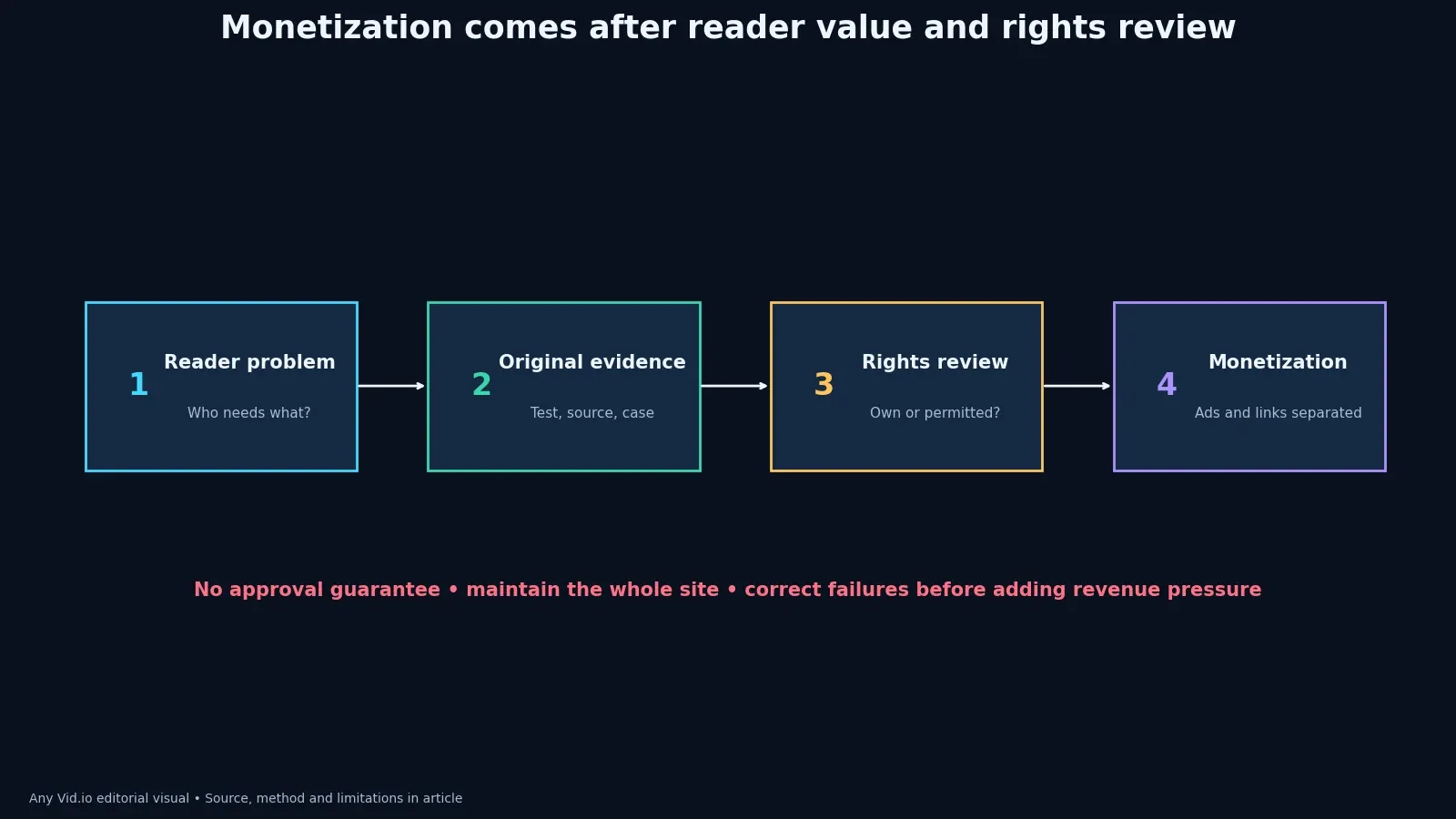
Design ads around the reading task
Keep advertising distinguishable from navigation, download controls and primary instructions so a reader is not tricked into clicking an ad that resembles the utility.
Keep ads away from the primary form, playback controls and explanatory steps. On a narrow phone screen, check the page while the keyboard is open and while the result is loading; an ad that shifts into a tap target is a usability failure. Reserve space for known units so late loading does not push the reader past the instruction or button they intended to use. Review the same flow without assuming an AdSense approval decision proves the layout is helpful.
Measure layout shift and loading behavior on representative mobile pages, then inspect the affected viewport rather than changing every template for a score. The reader should be able to understand the rights limitation, use the utility and find the supporting explanation without an ad obscuring any step. Recheck after theme or ad-unit changes, because a sound editorial policy can be undermined by the rendered layout.
Make the publisher checklist part of pre-publication review: rights wording, cited evidence, claim limits, ad placement and a working mobile path. Keep the reviewer’s notes with the article. A later editor can then distinguish a deliberate choice from a missing check when a platform policy or advertisement implementation changes.
Build trust signals that are real
Apply Google's people-first content guidance to the actual page: state who prepared it, explain the method behind a test and show the source of any platform rule. If a case study is illustrative, label it that way rather than presenting a scenario as observed traffic or revenue. The reader should be able to tell which assertions came from published guidance and which came from the publisher's own bounded test.
Maintain About, Contact, Privacy, Terms and Disclaimer pages and link them in context when identity, data handling or legal limits matter.
Use source-led disclosure lessons from the Lord & Taylor case study without pretending one enforcement case answers every jurisdiction.
Maintain a corrections log for uncertain policy or product claims. Record the date checked, the exact publisher source and the next review date. When a control varies by account or region, describe that limitation close to the instruction instead of claiming every creator sees the same screen. An honest uncertainty statement is more useful than a confident instruction that fails in the reader's account.
Diversify revenue without corrupting the page
Consider creator services, templates, sponsorships, memberships or products only when they match the publication’s demonstrated expertise and can be accurately supported. For a creator publisher trying to monetize downloader-related search traffic responsibly, the rejected option may be the most valuable part of the method: it prevents a fast-looking shortcut from becoming the default.
Use the UGC pricing and usage-rights guide when a service involves client media rather than quietly bundling broad rights into a low fee.
Track corrections, support questions and repeat use alongside revenue. If visitors repeatedly misunderstand permissions or confuse an advertisement for a download button, address the page and interface before treating the traffic as a success. Keep revenue reports separate from evidence about whether readers completed the legitimate task; each measure answers a different question.
Preserve a dated copy of the article and its policy sources when making a material change. A later review can then explain why the wording moved, whether an ad position was adjusted and whether a previously cited source disappeared. Do not silently change a legal or platform claim based on an undated recollection.
Audit the whole site quarterly
Sample articles, category pages, tool states and mobile layouts for thin repetition, broken sources, aggressive claims, unclear ads and outdated platform steps.
Compare proposed pages by reader job before publishing another variation. One guide about recovering your own Instagram master and another about diagnosing a damaged export can coexist; several pages that merely reorder 'fast', 'free' and 'HD' promises offer little independent value. Record the primary question and the evidence each URL contributes. If two drafts cannot be distinguished without their headline keywords, improve the drafts rather than launching both.
Use the downloader search-intent case study to keep each URL attached to a distinct reader problem. Assign an editor to revisit platform-specific steps and source links. When the facts change, update the answer and its evidence rather than adding another nearly identical page to cover a new phrase.
A publisher review should be able to answer three concrete questions: what legitimate creator task does this page solve, what evidence distinguishes it from the neighboring pages, and can the reader tell editorial guidance from advertising? Record any failed answer as a revision task. No wording or checklist guarantees AdSense approval or search visibility.
Review monetization and editorial value separately
Print the draft or view it without advertisements, calls to action and product references. Ask whether a rights-holding creator could complete a useful task from the remaining reporting, table, chart and workflow. If the answer is no, the page needs more original value before it needs better monetization. Add first-hand testing, a decision matrix, error recovery and clear limitations—not a longer keyword introduction. This review does not predict an ad-network decision, because approval and enforcement consider policies and the site as a whole, but it exposes thin pages that depend on commercial framing to appear useful.
Run a separate link review after the editorial review. Classify every destination as primary evidence, contextual reading, internal navigation, product, purchase, signup, affiliate or paid placement. Evidence links should sit beside the claim they support. Commercial or compensated destinations must receive the appropriate rel treatment, including sponsored and nofollow when required, and anchor text should describe the destination without pretending endorsement. Keeping this review separate prevents a useful citation from being removed merely because the page has monetization, and prevents a sales path from being disguised as neutral documentation.
Use an issue log for the whole site, not just the seven new pages. Sample older downloader pages for unsupported universals, access-control advice, copied descriptions, broken sources and claims that public availability equals reuse permission. Give severe issues an owner and correction date before expanding the cluster. Record what changed and why. A publisher cannot guarantee AdSense approval through a checklist, yet it can demonstrate disciplined maintenance: original purpose, current sources, rights-first instructions, accessible presentation and monetization that does not overwhelm or mislabel the editorial work.
Case-study table
| Control | Passing evidence | Failure signal | Editorial response |
|---|---|---|---|
| Independent value | Original test, workflow, source or template | Page is useless without the tool button | Expand the answer or remove the page |
| Lawful positioning | Rights language at the relevant step | “Any public video” or bypass framing | Rewrite scope and block unsafe instructions |
| Commercial transparency | Clear disclosure and qualified links | Hidden commission or tracking-heavy citation | Disclose, qualify or remove |
| Ad separation | Ads visually distinct from controls | Ad resembles a download button | Redesign placement before monetizing |
| Maintenance | Named owner and factual review date | Old screenshots and broken platform steps | Refresh, consolidate or retire |
| Site trust | Accurate authorship and reachable policies | Anonymous mass pages and unsupported claims | Add real accountability, not badges |
Use the table to record each page's audience, independent evidence, rights wording, source checks and ad review. Its purpose is to expose unresolved work before publication; it is not a policy certification or a promise of approval.
Put the method to work
Audit one high-traffic page as if the ads and tool were absent. If the remaining article still resolves a creator problem with evidence, rights clarity and honest limitations, the foundation is sound. If nothing useful remains, the priority is editorial repair—not another monetization unit.
Explore the creator-business and publishing guides on the AnyVid.io blog. No strategy can guarantee AdSense approval, search ranking or revenue; current policies and the complete live implementation must be reviewed.
AnyVid.io Editorial Team
The AnyVid.io Editorial Team publishes practical guides on short-form video production, AI-assisted creator workflows, Instagram and TikTok strategy, video SEO, audience growth and creator monetization.
Frequently asked questions
Does this strategy guarantee Google AdSense approval?
No. Nobody outside Google can guarantee approval, continued eligibility, rankings or earnings. This strategy aims to build useful, transparent, policy-aware content, but the site and implementation must be reviewed against current requirements. Record the route, date and result in an editorial and monetization control sheet so the same question can be checked against future platform or workflow changes.
Are video downloader keywords automatically prohibited?
Not inherently, but the content and utility must be evaluated. Pages that encourage copyright infringement, bypass controls, deceive users or provide little original value create serious risks. Rights-respecting creator education is a different editorial proposition. For a creator publisher trying to monetize downloader-related search traffic responsibly, the safest next step is a reversible test with one authorized file and a written result rather than a universal assumption.
How often should AnyVid.io promote its own utility?
Only when it naturally helps with the lawful task being discussed. Most of the article should solve the reader’s problem independently through official routes, source preservation, quality checks, troubleshooting and rights guidance. Keep the evidence tied to original value, policy review, disclosure quality and audience usefulness; that prevents a convenient observation from becoming a broader claim than the case study supports.
Can affiliate links appear in these articles?
They can only be considered when genuinely useful and clearly disclosed. AnyVid.io’s policy is rel="sponsored nofollow" for affiliate, paid-placement and compensated commercial links. A commission must never determine the editorial verdict. If building a thin utility funnel that appears to encourage unauthorized copying remains possible, preserve the original state and ask for rights or technical review before changing the only surviving copy.
What makes a downloader article more than thin content?
Original measurements, primary-source research, a complete workflow, real limitations, rights guidance, accessible tables, troubleshooting and a reusable template can create independent value. Swapping platform names in the same shallow article does not. Record the route, date and result in an editorial and monetization control sheet so the same question can be checked against future platform or workflow changes.
Should ads appear next to download buttons?
Avoid placements that could confuse an advertisement with navigation, a file link or a tool control. Ads should be clearly distinguishable and should not cause accidental interaction, cover content or interrupt the essential task. For a creator publisher trying to monetize downloader-related search traffic responsibly, the safest next step is a reversible test with one authorized file and a written result rather than a universal assumption.
Was this article helpful?
Tell us what worked so we can improve future content.