
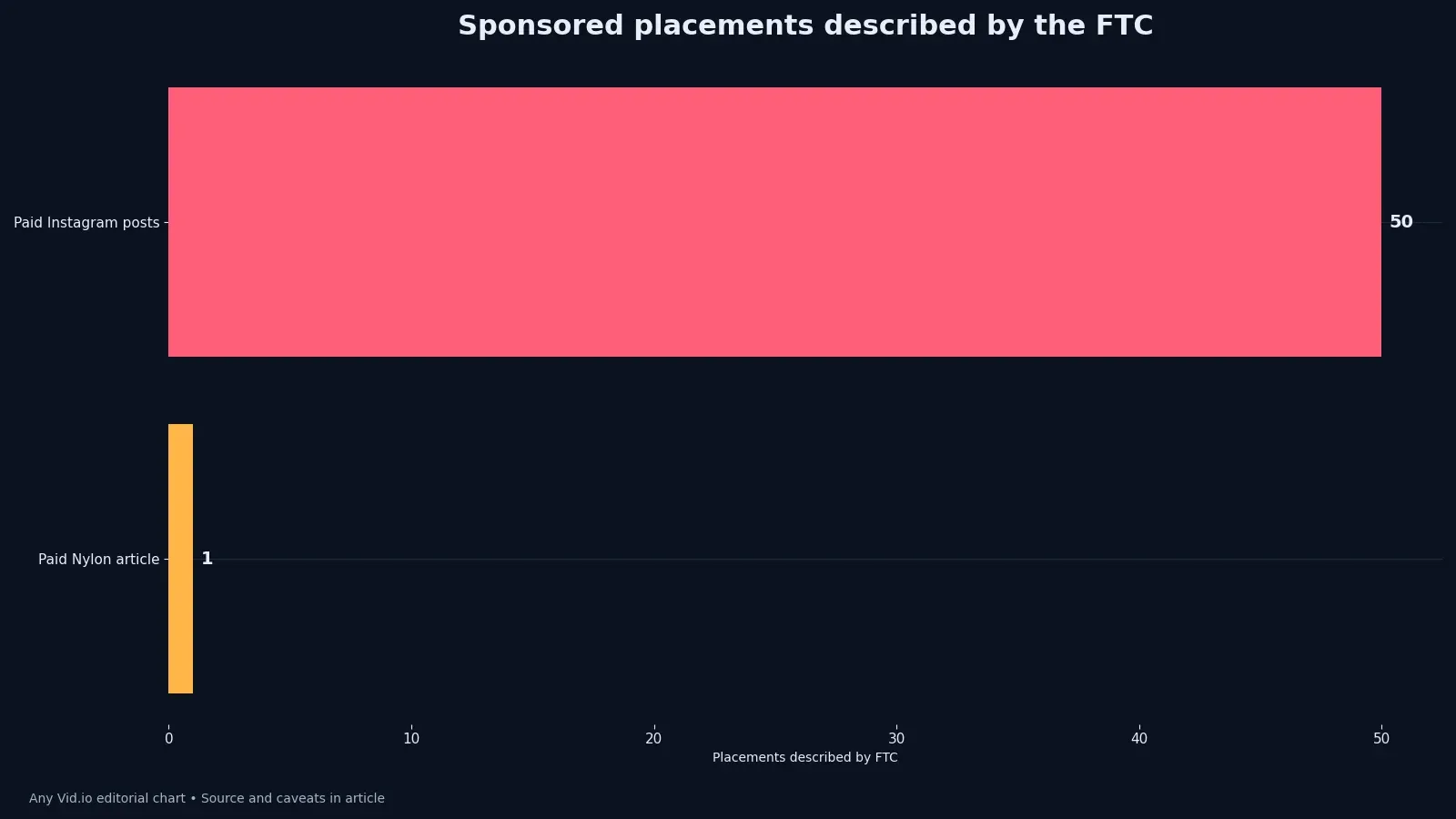
In 2015, Lord & Taylor promoted a dress collection through native advertising and influencer posts. The Federal Trade Commission later alleged that the company paid 50 fashion influencers to post Instagram photos wearing the same dress without requiring disclosure of the compensation, and that a paid Nylon article also lacked adequate commercial context. The matter settled in 2016 without a civil penalty, but with an order governing future conduct.
This historical case is not a substitute for current legal advice. The FTC revised its Endorsement Guides in 2023, platforms maintain their own branded-content tools, and rules outside the United States differ. The durable operational lesson is that disclosure cannot be left to memory after creative approval. It must be written into the brief, visible in the content, checked before publication and preserved with the campaign record.
Reconstruct the campaign record
Identify the 50 paid Instagram placements, the Nylon article and the company’s role in approving influencer posts. The next test should be cheaper than the story that inspired it. Use existing footage, a limited archive, a single sponsor brief or a short run of posts. Decide in advance what would make you stop, continue or revise. Pre-committing to those choices reduces the temptation to explain every noisy result as proof that the idea was right.
Keep allegation, settlement and current law distinct; a settlement record is not a jury verdict on every disputed fact. Finally, preserve editorial judgment. Data can expose a pattern and a case can demonstrate feasibility, but neither can decide what is responsible for your audience, sustainable for your capacity or consistent with your voice. The creator still owns that decision—and should be able to explain it without hiding behind an algorithm or a benchmark.
Avoid turning absence of a civil penalty in this matter into a claim that noncompliance has no consequences. The important distinction is between what the record establishes and what an editor might infer. A published outcome can show that a particular team changed a particular system; it cannot prove that copying one visible tactic will reproduce the number. Use the evidence to choose a test, then measure that test against your own baseline.
Find the operational control failure
The FTC’s account centers on material connections that viewers were not adequately told about. In practice, turn that observation into a written decision before opening the camera or editor. Name the audience question, the asset that will answer it, and the signal that would justify keeping the change. This keeps a striking result from becoming a vague command to ‘do more’ and gives collaborators something concrete to challenge.
Creative review did not reliably ensure that each paid post carried clear disclosure. The failure mode is easy to recognize: the headline number survives while the conditions disappear. Sample size, time window, content library, distribution surface and measurement definition all shape the result. Keep those conditions beside the metric in the project notes, especially when the source is a platform, vendor or company describing its own success.
Responsibility cannot be outsourced to a creator’s assumptions or a vague contract clause nobody checks at publication. A small creator can still use the lesson without imitating the scale. Reduce the operation to one page, one video family or one campaign. Establish the current state, change one coherent bundle of decisions, and wait long enough for the relevant behavior to occur. If several variables move together, describe the result as a package rather than crediting a favorite detail.
Write disclosure into the brief
State the material connection, required wording or tool, placement expectation and language variants before production begins. Success should be visible in the work as well as the dashboard. A cleaner page should be easier to inspect; a stronger disclosure should be harder to miss; a better edit should answer the viewer sooner. When a metric rises but the audience experience becomes less accurate or less accessible, the experiment has found a trade-off, not an uncomplicated win.
Make disclosure a pass/fail approval field separate from aesthetics, brand claims and file delivery. Document the unsuccessful pass too. Rejected versions show which constraints mattered and stop the team from repeating an attractive mistake six weeks later. A useful record needs the date, source material, decision owner, changed element, observation window and one sentence about uncertainty. That is enough structure for learning without building a bureaucracy.
Require creators to flag gifted products, affiliate compensation and other connections that may alter what a viewer reasonably understands. Treat the chart as a map of the published evidence, not a forecast. It compresses the reported values so patterns are easier to see, but it does not add precision the source never supplied. Thresholds such as ‘more than’ or ‘fewer than’ remain thresholds, and indexed pages, clicks, traffic and engagement must not be silently treated as the same outcome.
Review the actual post in context
Check disclosure where viewers encounter the endorsement, not only in a profile, buried hashtag group or separate terms page. Before generalizing, ask what else changed at the same time. A creator may alter cadence, subject, collaboration and presentation together; a publisher may add markup while fixing indexing; a production may combine generation with conventional editing. The honest conclusion is often that the workflow bundle worked under observed conditions, while the contribution of each part remains unknown.
Review the first visible lines, spoken content, overlays and platform tool together. The next test should be cheaper than the story that inspired it. Use existing footage, a limited archive, a single sponsor brief or a short run of posts. Decide in advance what would make you stop, continue or revise. Pre-committing to those choices reduces the temptation to explain every noisy result as proof that the idea was right.
Recheck after publication because cropping, truncation or interface changes can alter visibility. Finally, preserve editorial judgment. Data can expose a pattern and a case can demonstrate feasibility, but neither can decide what is responsible for your audience, sustainable for your capacity or consistent with your voice. The creator still owns that decision—and should be able to explain it without hiding behind an algorithm or a benchmark.
Preserve truthful creator judgment
A disclosure does not cure a false experience, unsupported claim or endorsement the creator does not genuinely hold. The important distinction is between what the record establishes and what an editor might infer. A published outcome can show that a particular team changed a particular system; it cannot prove that copying one visible tactic will reproduce the number. Use the evidence to choose a test, then measure that test against your own baseline.
Keep evidence for objective product claims supplied by the brand and reject claims outside that support. In practice, turn that observation into a written decision before opening the camera or editor. Name the audience question, the asset that will answer it, and the signal that would justify keeping the change. This keeps a striking result from becoming a vague command to ‘do more’ and gives collaborators something concrete to challenge.
Document substantive edits so a creator’s words are not repurposed into a stronger or different claim. The failure mode is easy to recognize: the headline number survives while the conditions disappear. Sample size, time window, content library, distribution surface and measurement definition all shape the result. Keep those conditions beside the metric in the project notes, especially when the source is a platform, vendor or company describing its own success.
Monitor the campaign proportionately
Use a campaign checklist and spot review process focused on contracted posts rather than invasive monitoring of unrelated creator activity. A small creator can still use the lesson without imitating the scale. Reduce the operation to one page, one video family or one campaign. Establish the current state, change one coherent bundle of decisions, and wait long enough for the relevant behavior to occur. If several variables move together, describe the result as a package rather than crediting a favorite detail.
Record correction requests, response time and final state. Success should be visible in the work as well as the dashboard. A cleaner page should be easier to inspect; a stronger disclosure should be harder to miss; a better edit should answer the viewer sooner. When a metric rises but the audience experience becomes less accurate or less accessible, the experiment has found a trade-off, not an uncomplicated win.
Escalate repeated failures and pause paid distribution when disclosure or claims remain materially defective. Document the unsuccessful pass too. Rejected versions show which constraints mattered and stop the team from repeating an attractive mistake six weeks later. A useful record needs the date, source material, decision owner, changed element, observation window and one sentence about uncertainty. That is enough structure for learning without building a bureaucracy.
Connect rights with disclosure
A brand’s right to reuse a video does not remove the need to assess disclosure in the new placement. Treat the chart as a map of the published evidence, not a forecast. It compresses the reported values so patterns are easier to see, but it does not add precision the source never supplied. Thresholds such as ‘more than’ or ‘fewer than’ remain thresholds, and indexed pages, clicks, traffic and engagement must not be silently treated as the same outcome.
Paid amplification, whitelisting and edited variants can change what a viewer understands about the speaker and sponsor. Before generalizing, ask what else changed at the same time. A creator may alter cadence, subject, collaboration and presentation together; a publisher may add markup while fixing indexing; a production may combine generation with conventional editing. The honest conclusion is often that the workflow bundle worked under observed conditions, while the contribution of each part remains unknown.
Tie each permitted use to a disclosure owner and renewal date in the licensing schedule. The next test should be cheaper than the story that inspired it. Use existing footage, a limited archive, a single sponsor brief or a short run of posts. Decide in advance what would make you stop, continue or revise. Pre-committing to those choices reduces the temptation to explain every noisy result as proof that the idea was right.
Use a preflight evidence record
Save the signed brief, final script, claim support, disclosure screenshot, live URL and approved file. Finally, preserve editorial judgment. Data can expose a pattern and a case can demonstrate feasibility, but neither can decide what is responsible for your audience, sustainable for your capacity or consistent with your voice. The creator still owns that decision—and should be able to explain it without hiding behind an algorithm or a benchmark.
Capture the post as viewers saw it at launch without saving media you do not own or have permission to archive. The important distinction is between what the record establishes and what an editor might infer. A published outcome can show that a particular team changed a particular system; it cannot prove that copying one visible tactic will reproduce the number. Use the evidence to choose a test, then measure that test against your own baseline.
Schedule an expiry check for paid usage and corrections. In practice, turn that observation into a written decision before opening the camera or editor. Name the audience question, the asset that will answer it, and the signal that would justify keeping the change. This keeps a striking result from becoming a vague command to ‘do more’ and gives collaborators something concrete to challenge.
Evidence table
| Campaign control | Failure illustrated by case | Creator-side safeguard |
|---|---|---|
| Material connection | Paid relationship not adequately disclosed | Clear disclosure in content context |
| Approval | Posts were reviewed without fixing disclosure | Separate disclosure gate |
| Native article | Paid editorial placement lacked context | Label sponsorship where article is consumed |
| Recordkeeping | Scale increased coordination risk | Per-placement evidence log |
This evidence table for The Lord & Taylor Instagram Case: A Disclosure Workflow Creators Can Use is deliberately compact. It preserves the unit and limitation beside each result so the number cannot wander into a slide deck as an unsupported universal benchmark. For a working analysis, add the date you accessed the source and the exact metric definition used in your own account.
Source and method
This case study relies on FTC: Lord & Taylor case—clear disclosure is the rule. The chart redraws only values stated by that source or transparent transformations described in its caption. No private dashboard data, invented survey, simulated outcome or scraped personal information is presented as fact.
For this Creator Monetization analysis, any interest held by a platform or company reporting its own result is named; academic designs and dates remain visible. The source link lets readers inspect the original wording, while current feature or legal questions should still be checked against current primary guidance before action.
Apply the case without copying it
Choose one bounded project and write a baseline before making changes. Preserve the case’s logic—clear variables, visible evidence and honest limitations—without imitating its scale or headline outcome. Read Build a Sponsorship Delivery System Before Pitching Brands. Read Price and License UGC Deliverables. Read A Responsible AI Video Workflow From Prompt to Disclosure.
Review the Creator Monetization result with the people who make and use the content. Keep what improves clarity, trust or sustainable production; revise what merely chases the published number. Browse the AnyVid.io blog for more creator workflows. When archiving reference media, use only media you created, own, or have permission or another lawful right to save.
Frequently asked questions
Were the influencers fined in the Lord & Taylor settlement?
The FTC’s 2016 announced settlement was with Lord & Taylor and did not impose a civil penalty in that matter. Do not generalize that outcome to other cases. Enforcement tools, facts and current guidance can differ.
Is using a platform paid-partnership label enough?
Use the platform tool where appropriate, but also assess whether the material connection is clear and hard to miss in the actual content context. Current FTC guidance and local law matter; platform features do not replace legal obligations.
Where should a disclosure appear?
Close to the endorsement and where viewers will notice it before or as they receive the claim. Avoid burying it after truncation, in a dense hashtag block or only on a profile page. Spoken and visual disclosures may both be appropriate for video.
Does disclosure make any product claim acceptable?
No. Endorsements should reflect honest experience, and objective claims need appropriate support. Disclosure tells viewers about the relationship; it does not transform a false or unsubstantiated claim into a truthful one.
What should a creator save after a sponsored post?
Keep the brief, contract, final approved copy, claim support, disclosure decision, publication URL, launch screenshot, correction record and usage expiry. Store only content you created, own or have a lawful right to retain.
Was this article helpful?
Tell us what worked so we can improve future content.