
An affiliate article becomes unhelpful when the commission decides the verdict before the testing begins. Readers notice the pattern: every option is excellent, every drawback is minor, and the strongest button appears before the evidence. Search engines are not the only audience harmed by that design. The creator loses the ability to make a recommendation people can distinguish from a catalog.
The FTC’s influencer disclosure guidance says material connections should be obvious and placed with the endorsement. Google’s outbound-link qualification guidance identifies <code>sponsored</code> as the preferred value for paid links and accepts <code>nofollow</code>; multiple values can be used together. AnyVid.io therefore uses <code>rel="sponsored nofollow"</code> on affiliate, paid-placement and other compensated commercial links. This article itself includes no affiliate product link.
Begin with a reader decision
Define the exact decision: which microphone suits an untreated room, whether an editing subscription replaces an existing step, or when a free option is sufficient. The final artifact should be reusable. Save the approved language, measurement definition, visual reference and result beside the project—not only the finished file. Future work improves when the reasoning survives after the timeline and chat messages disappear. Keep raw counts where the interface permits and describe any missing fields. Rates are easier to compare, but counts expose tiny samples and sudden distribution changes. Never reconstruct a denominator from rounded percentages when the platform does not provide it.
Name the reader’s constraints before naming products. Budget, device, region, accessibility, return policy and workflow compatibility determine whether a feature matters. Do not reward a surprising result with a new myth. Check the raw observation, inspect outliers, and ask whether the metric answered the original question. The strongest conclusion may be narrower than the headline, but it will be more useful when the next project differs from this one. Turn the lesson into a checklist item that appears before the next irreversible step. Advice stored only in a retrospective is easy to admire and easy to ignore. Placement in the workflow is what converts analysis into a repeatable safeguard.
Use the service and offer logic in the creator revenue resilience plan to avoid making commissions the only business layer. Accessibility belongs in the production logic, not the last export pass. Captions, legible graphics, spoken context and controlled motion affect who can use the work and how confidently they can follow it. Include those checks before judging retention or conversion. If collaborators are involved, agree on the metric definition and approval standard before work begins. Editors, clients and creators often use the same word for different outcomes. One written example prevents a later argument about what ‘engagement,’ ‘usable’ or ‘approved’ meant.
Document first-hand evidence
Record what you personally tested, for how long, with which version and under what conditions. Separate direct observation from manufacturer specifications and other people’s reporting. That sounds simple, but it changes the working question. Instead of asking whether the post was ‘good,’ the review asks which promise was made, what evidence the viewer received, and where the result departed from the plan. A useful note names the next decision; a vague verdict merely preserves the team’s mood. Review the work at normal speed before frame-by-frame inspection. Severe artifacts deserve technical attention, but a microscopic flaw that no viewer can perceive should not automatically outrank story clarity, accessibility, consent or the promised practical result.
Keep rejected options and failure notes. A useful comparison explains where a product does not fit, including the circumstance where the cheaper or existing tool is enough. Put this in the project brief before production. The brief should identify the intended viewer, the observable behavior, the review window and the person empowered to stop the test. Pre-committing prevents a large reach number from erasing cost, confusion, weak fit or an uncomfortable audience response after the fact. Preserve the version that served as the baseline. Without it, improvement becomes a story told by the newest file. A side-by-side comparison also helps the team avoid fixing one visible weakness by quietly introducing a different problem elsewhere.
Update time-sensitive price and availability claims or omit exact values when they cannot be maintained. Never use a stale discount as artificial urgency. The common mistake is to preserve the number while dropping its denominator and conditions. A percentage, rate or multiplier only makes sense beside the sample, time window, content type and source. Keep those details in the same row of the worksheet so a later presentation cannot quietly turn a bounded finding into universal advice. When the outcome is mixed, resist averaging incompatible signals into a single score. State what improved, what worsened and what stayed unknown. A qualified decision is more actionable than a composite number whose weighting nobody can defend.
Make the disclosure unmissable
Put a plain-language disclosure near the recommendation and link, where a person encounters the endorsement. A legal page alone does not explain the relationship at the decision point. Success has to be visible outside analytics. The piece should answer the promised question more clearly, take less fragile labor, create a better conversation or lead to an appropriate business action. If the metric rises while trust or accuracy falls, the experiment has exposed a trade-off rather than a win. Consider the people excluded by the measurement. Silent viewers, people using captions, subscribers arriving later and clients judging deliverables may matter even when the dashboard centers immediate public reactions. Add a qualitative check for the audience the metric cannot describe.
Use words the audience understands, such as that you may earn a commission if they buy. Do not hide the relationship behind vague labels like ‘collab’ or an ambiguous icon. Record the rejected version too. Failed openings, unusable generations and broken exports reveal constraints that a polished final cut hides. A compact log—date, source, change, owner, result and uncertainty—is enough to prevent the same attractive mistake from returning in the next production cycle. Finally, date the recommendation. Platform controls, pricing, support and technical requirements change, while the article’s underlying decision method should remain useful. A visible access date makes later verification routine instead of treating old operational details as permanent facts.
The enforcement lessons in the Lord & Taylor disclosure case study show why a campaign brief needs disclosure controls before creators publish. Treat the visual in this article as an aid to reasoning, not a forecast. It either redraws numbers published by the named source or carries an explicit illustrative label. The chart does not create precision, causality or platform-wide guidance that the underlying material never supplied. For the working review, capture one screenshot or export from the relevant stage, write the exact setting or audience condition, and compare it with the planned result. Evidence that can be revisited is more reliable than a confident recollection after publication.
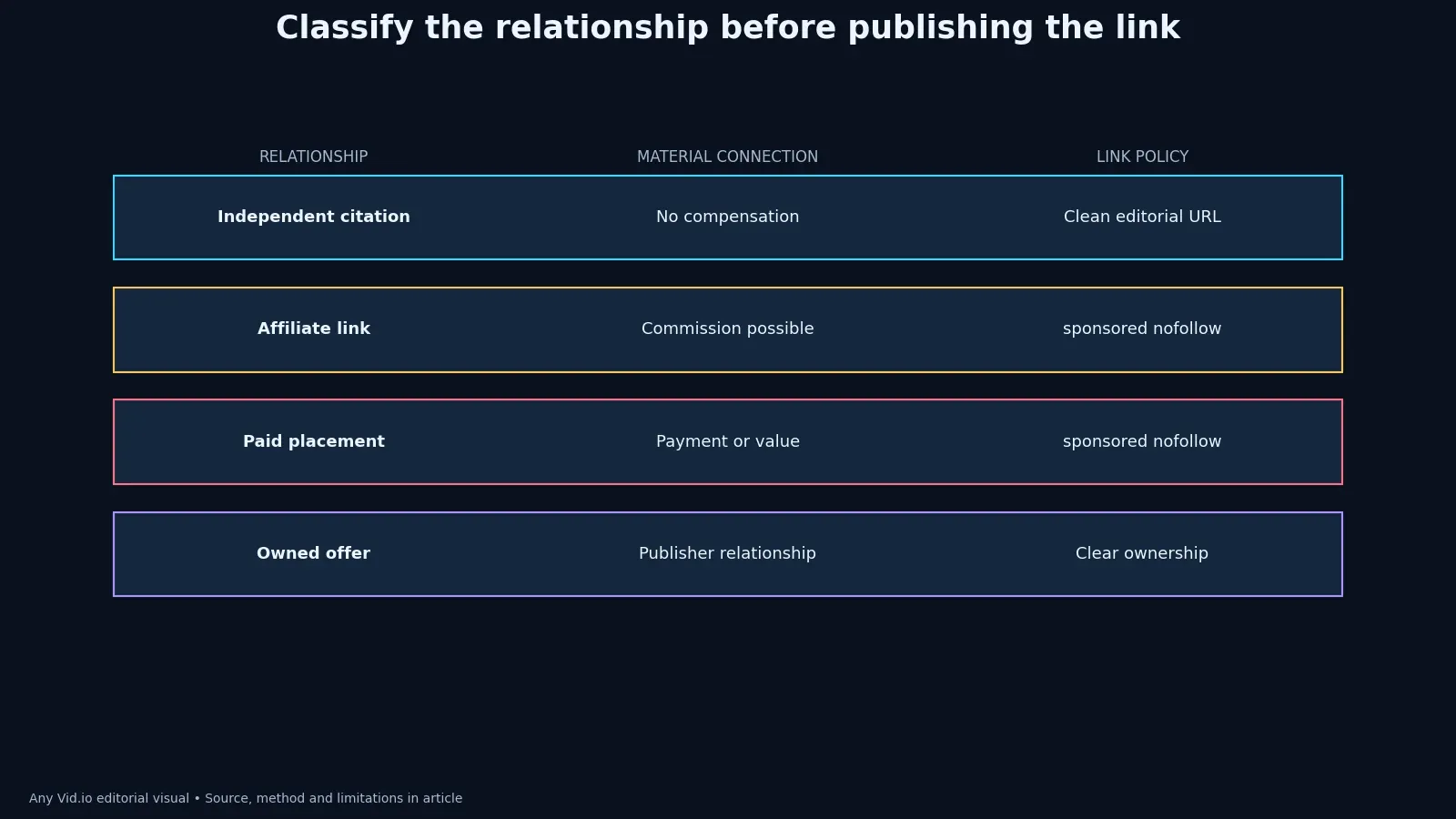
Apply link attributes by relationship
Use <code>rel="sponsored nofollow"</code> for affiliate and paid-placement links under this publication policy. Keep the disclosure visible in prose as well; an HTML attribute is not a reader disclosure. Make the next test cheaper than the claim that inspired it. Reuse lawful source material, limit the number of variants, and define what would make you continue, revise or stop. A small test protects time and reputation while still producing information that can improve the next brief. Ask a second person to follow the instruction without verbal coaching. Note the point where they hesitate, the assumption they make, and the proof that resolves it. Those observations often reveal a better edit than another round of generalized polishing.
A clean citation to a government, academic or standards source does not become sponsored merely because it is external. Classify the relationship, not the domain’s popularity. Editorial judgment remains the final control. Data can reveal a pattern and documentation can reduce ambiguity, but neither decides what suits the creator’s voice, capacity or duty to the audience. Someone should be able to explain the decision in plain language without invoking a mysterious algorithm. Set the review date while the decision is still emotionally neutral. Early checking rewards noise; indefinite checking encourages selective memory. A fixed window gives comparable work the same opportunity and makes exceptions visible when outside events genuinely require them.
Do not add tracking parameters to editorial citations. When an affiliate program legitimately requires tracking, keep the destination transparent and apply the required disclosure and sponsored relationship. Look for the failure at the handoff. A sound idea can be weakened when the script becomes a shot list, when the shot becomes an edit, or when the export reaches a platform. Naming the handoff makes troubleshooting faster because the team tests one boundary instead of rebuilding the entire piece. Write the alternative explanation beside the preferred one. If both fit the observation, the result is not yet diagnostic. The next version should separate them with a different shot, audience segment, delivery check or deliberately held-constant production choice.
Design the page around evidence
Place methodology, trade-offs and comparison criteria before the strongest commercial call to action. The reader should be able to reject the recommendation intelligently. The audience should not have to reverse-engineer the premise. Use concrete nouns, observable actions and an early indication of the payoff. That does not require frantic editing; it requires alignment between packaging and what the video actually delivers. Keep raw counts where the interface permits and describe any missing fields. Rates are easier to compare, but counts expose tiny samples and sudden distribution changes. Never reconstruct a denominator from rounded percentages when the platform does not provide it.
Link supporting sources at the claim they support instead of collecting them in a decorative list at the end. Context lets the reader inspect the evidence without guessing. Operationally, assign this decision a home. It might live in the storyboard, rights log, offer sheet, export checklist or analytics review, but it should not depend on memory. The best systems make the responsible action easier at the moment pressure is highest. Turn the lesson into a checklist item that appears before the next irreversible step. Advice stored only in a retrospective is easy to admire and easy to ignore. Placement in the workflow is what converts analysis into a repeatable safeguard.
For client or UGC deals, pair the recommendation workflow with the UGC pricing and usage-rights guide because content fees and downstream usage are separate questions. Avoid solving uncertainty with extra volume. More versions, more posts or more links can create the appearance of effort while making attribution harder. Add another variable only when the current test has answered the question it was designed to answer. If collaborators are involved, agree on the metric definition and approval standard before work begins. Editors, clients and creators often use the same word for different outcomes. One written example prevents a later argument about what ‘engagement,’ ‘usable’ or ‘approved’ meant.
Measure value beyond clicks
Track corrections, refund complaints, return visits, email replies and content maintenance alongside outbound clicks and revenue. A high-click article can still be a weak long-term asset. Quality control should happen on the device and in the context where the audience encounters the work. Studio monitors, editing previews and internal terminology can hide ordinary viewing problems. Watch the delivered result, read the surrounding copy, and verify the action a real viewer can take. Review the work at normal speed before frame-by-frame inspection. Severe artifacts deserve technical attention, but a microscopic flaw that no viewer can perceive should not automatically outrank story clarity, accessibility, consent or the promised practical result.
Review whether commissions changed editorial coverage: products added without a reader need, drawbacks softened, or alternatives removed because they do not pay. Keep the human cost in the same table as the performance signal. Minutes of filming, review burden, moderation, revisions and emotional exposure are part of the result. A tactic that produces a modest lift by doubling fragile labor may be a poor system even when the dashboard looks better. Preserve the version that served as the baseline. Without it, improvement becomes a story told by the newest file. A side-by-side comparison also helps the team avoid fixing one visible weakness by quietly introducing a different problem elsewhere.
Create an exit rule for a partner whose claims, fulfillment or support no longer meet the article’s evidence. Revenue never converts a misleading recommendation into a useful one. When a source is a platform or vendor describing its own ecosystem, use the information without borrowing the sales conclusion. Preserve the sample and method, compare it with your own evidence, and link to the original so readers can inspect the context. Citation is not endorsement. When the outcome is mixed, resist averaging incompatible signals into a single score. State what improved, what worsened and what stayed unknown. A qualified decision is more actionable than a composite number whose weighting nobody can defend.
Working table
| Relationship | Reader disclosure | Link treatment for AnyVid.io |
|---|---|---|
| Independent editorial citation | Explain the source where context requires it | Clean URL; no affiliate tracking |
| Affiliate commission | Clear commission disclosure near endorsement | rel="sponsored nofollow" |
| Paid placement or advertorial | Prominent paid/sponsored disclosure | rel="sponsored nofollow" |
| Gifted product with expected coverage | Disclose the material connection | Conservative sponsored nofollow treatment |
| Owned product or service | State ownership clearly | Use accurate internal or owned destination without disguising the relationship |
Use this table as the working decision record for Affiliate Content Without the Trust Tax: A Creator Publishing System, not as decorative authority. Replace illustrative entries with dated observations from the real project, keep definitions beside the result, and preserve the source whenever a published fact changes the decision. The useful row is the one that tells the next editor what to verify.
Put the method to work
Audit one existing recommendation from the reader’s point of decision. Put the relationship in plain language, expose the trade-offs and correct the link attributes. If the page becomes less persuasive when the evidence is honest, the offer was never the strongest part of the article.
Explore more creator-business systems on the AnyVid.io blog. No monetization technique guarantees income, and a commercial relationship should become clearer—not harder to find—as a reader approaches a purchase.
Frequently asked questions
Where should an affiliate disclosure appear?
Place a clear disclosure with the endorsement where readers are likely to notice it before acting. Do not rely only on a footer, profile page or legal policy. Exact obligations depend on jurisdiction and context, so review current applicable guidance.
What rel value should an affiliate link use?
AnyVid.io’s policy is rel="sponsored nofollow" for affiliate, paid-placement and compensated commercial links. Google identifies sponsored as the preferred value for paid links and also permits nofollow; multiple values can be combined.
Does nofollow replace an FTC disclosure?
No. A link attribute communicates with crawlers; it does not clearly tell a reader that the creator may benefit financially. Use a plain-language disclosure near the endorsement in addition to the appropriate HTML relationship.
Can an affiliate article still rank in search?
No one can guarantee ranking. The sound strategy is to satisfy a real decision with first-hand evidence, accurate comparisons, maintained claims and transparent relationships. Do not design the article around manipulating links or search systems.
Should every external product citation be labeled sponsored?
Not automatically. Sponsorship depends on the relationship. An independent editorial citation with no compensation is different from an affiliate or paid link. This publication still uses nofollow conservatively for commercial-company citations and sponsored nofollow whenever compensation exists.
Was this article helpful?
Tell us what worked so we can improve future content.