A film release is not one content moment. It is a sequence: expectation, first reaction, craft analysis, disagreement, comparison and eventual rediscovery. Creators who collapse that sequence into repeated ‘you need to watch this’ posts waste the most interesting part—the changing question the audience brings at each stage.
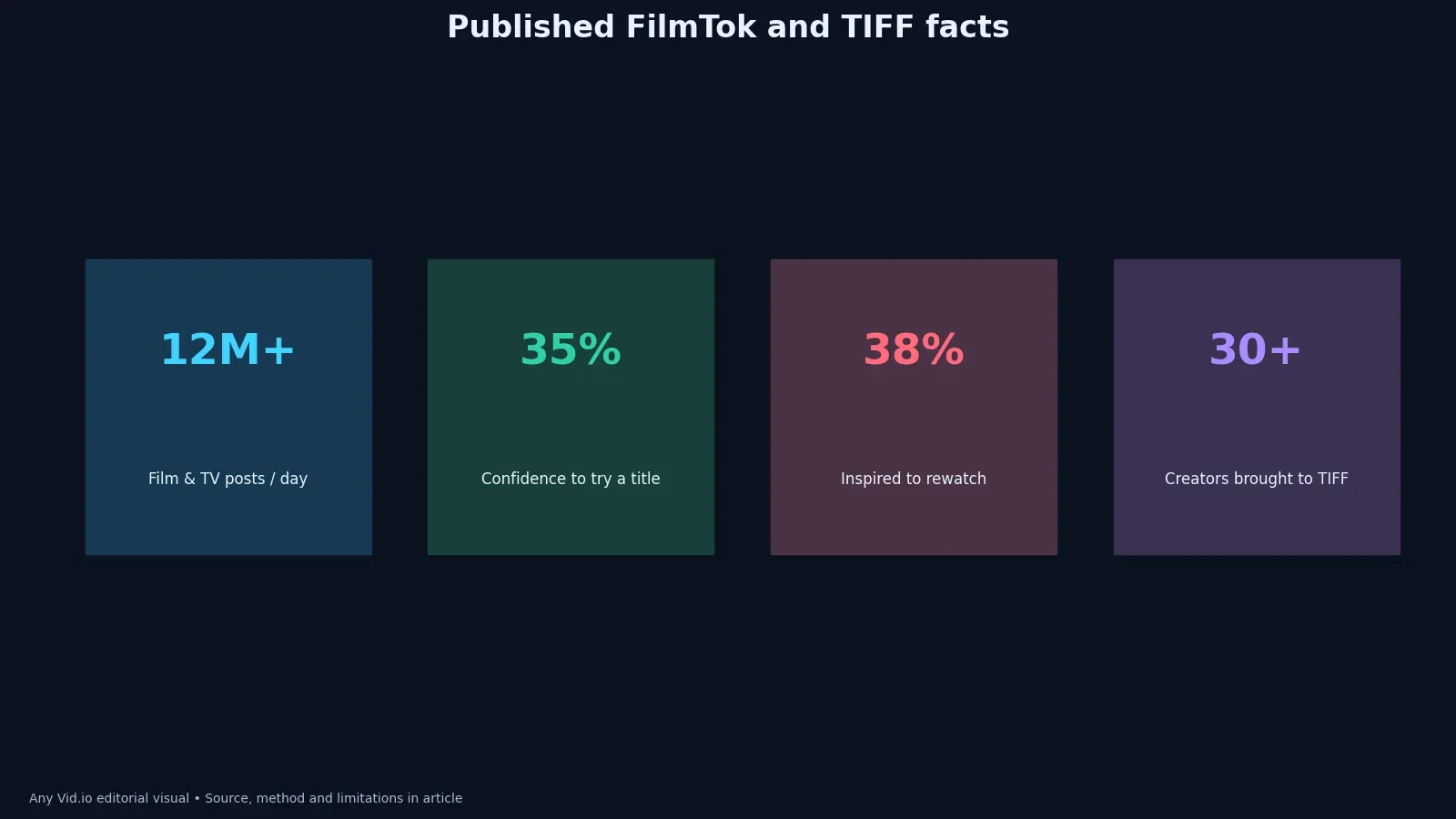
TikTok’s September 2026 TIFF announcement offers a timely case. The company reported more than 12 million Film and TV posts per day globally over the previous year, said 35% of surveyed users felt platform content gave them confidence to try a new movie or show, and said 38% had been inspired to rewatch an older title. TikTok also brought more than 30 FilmTok creators to TIFF. These are company-reported figures in a sponsorship announcement, not neutral proof of causal impact.
Read the source before the headline
Keep the research owner, survey wording and TIFF partnership beside every percentage. A solo creator can make the method smaller without making it sloppy. Use one content family, one delivery surface and a short observation window. Change a coherent variable, capture the result, and write down what else moved. The discipline matters more than the size of the dashboard. Write the alternative explanation beside the preferred one. If both fit the observation, the result is not yet diagnostic. The next version should separate them with a different shot, audience segment, delivery check or deliberately held-constant production choice.
Use Reuters’ reporting on TIFF’s younger-audience strategy for independent festival context rather than copying dates or access assumptions from creator posts. Success has to be visible outside analytics. The piece should answer the promised question more clearly, take less fragile labor, create a better conversation or lead to an appropriate business action. If the metric rises while trust or accuracy falls, the experiment has exposed a trade-off rather than a win. Keep raw counts where the interface permits and describe any missing fields. Rates are easier to compare, but counts expose tiny samples and sudden distribution changes. Never reconstruct a denominator from rounded percentages when the platform does not provide it.
Do not treat daily global post volume as a recommendation for individual frequency or as evidence that every title has demand. Record the rejected version too. Failed openings, unusable generations and broken exports reveal constraints that a polished final cut hides. A compact log—date, source, change, owner, result and uncertainty—is enough to prevent the same attractive mistake from returning in the next production cycle. Turn the lesson into a checklist item that appears before the next irreversible step. Advice stored only in a retrospective is easy to admire and easy to ignore. Placement in the workflow is what converts analysis into a repeatable safeguard.
Map the six-stage discovery cycle
Start with a searchable audience question, using the Creator Search Insights workflow when that feature is available to the account. Before copying the tactic, ask what else happened at the same time. Topic demand, audience composition, creative quality, distribution, seasonality and collaboration can all move together. An honest review often concludes that a bundle worked under specific conditions while the contribution of each component remains uncertain. If collaborators are involved, agree on the metric definition and approval standard before work begins. Editors, clients and creators often use the same word for different outcomes. One written example prevents a later argument about what ‘engagement,’ ‘usable’ or ‘approved’ meant.
Assign one angle each to anticipation, immediate reaction, craft, context, disagreement and rediscovery. Make the next test cheaper than the claim that inspired it. Reuse lawful source material, limit the number of variants, and define what would make you continue, revise or stop. A small test protects time and reputation while still producing information that can improve the next brief. Review the work at normal speed before frame-by-frame inspection. Severe artifacts deserve technical attention, but a microscopic flaw that no viewer can perceive should not automatically outrank story clarity, accessibility, consent or the promised practical result.
Give every angle a different evidence source so the series adds understanding rather than restating the same opinion. Editorial judgment remains the final control. Data can reveal a pattern and documentation can reduce ambiguity, but neither decides what suits the creator’s voice, capacity or duty to the audience. Someone should be able to explain the decision in plain language without invoking a mysterious algorithm. Preserve the version that served as the baseline. Without it, improvement becomes a story told by the newest file. A side-by-side comparison also helps the team avoid fixing one visible weakness by quietly introducing a different problem elsewhere.
Make access useful, not merely exclusive
Premiere or festival access matters only when the creator translates it into details an absent viewer can understand. Compare like with like. A tutorial, reaction, product demonstration and narrative scene ask different things of a viewer, so one universal target is rarely useful. Build a local comparison group with similar intent and duration, then keep the exceptions visible rather than averaging them away. When the outcome is mixed, resist averaging incompatible signals into a single score. State what improved, what worsened and what stayed unknown. A qualified decision is more actionable than a composite number whose weighting nobody can defend.
Separate what was observed directly from publicity materials, interviews and personal interpretation. The audience should not have to reverse-engineer the premise. Use concrete nouns, observable actions and an early indication of the payoff. That does not require frantic editing; it requires alignment between packaging and what the video actually delivers. Consider the people excluded by the measurement. Silent viewers, people using captions, subscribers arriving later and clients judging deliverables may matter even when the dashboard centers immediate public reactions. Add a qualitative check for the audience the metric cannot describe.
Disclose invitations, travel support, payment and other material connections clearly where audiences will notice them. Operationally, assign this decision a home. It might live in the storyboard, rights log, offer sheet, export checklist or analytics review, but it should not depend on memory. The best systems make the responsible action easier at the moment pressure is highest. Finally, date the recommendation. Platform controls, pricing, support and technical requirements change, while the article’s underlying decision method should remain useful. A visible access date makes later verification routine instead of treating old operational details as permanent facts.
Design the rediscovery post
A rewatch prompt needs a reason now: a craft detail, restored context, anniversary, thematic connection or new conversation. A useful review includes one sentence beginning ‘we still do not know.’ That sentence keeps observation separate from explanation. It also creates a clean opening for the next experiment instead of inviting a confident story built from incomplete evidence. For the working review, capture one screenshot or export from the relevant stage, write the exact setting or audience condition, and compare it with the planned result. Evidence that can be revisited is more reliable than a confident recollection after publication.
Mine recurring audience questions with the comment research loop instead of baiting nostalgia with an empty superlative. Quality control should happen on the device and in the context where the audience encounters the work. Studio monitors, editing previews and internal terminology can hide ordinary viewing problems. Watch the delivered result, read the surrounding copy, and verify the action a real viewer can take. Ask a second person to follow the instruction without verbal coaching. Note the point where they hesitate, the assumption they make, and the proof that resolves it. Those observations often reveal a better edit than another round of generalized polishing.
Respect licenses and clip permissions; commentary does not create blanket permission to upload another rights holder’s scenes. Keep the human cost in the same table as the performance signal. Minutes of filming, review burden, moderation, revisions and emotional exposure are part of the result. A tactic that produces a modest lift by doubling fragile labor may be a poor system even when the dashboard looks better. Set the review date while the decision is still emotionally neutral. Early checking rewards noise; indefinite checking encourages selective memory. A fixed window gives comparable work the same opportunity and makes exceptions visible when outside events genuinely require them.
Measure the cycle, not one hit
Tag posts by stage and compare discovery, depth and follow-through separately. Build an exit ramp before the test begins. State the safety, rights, workload or audience signal that would stop publication. Clear stopping rules help a team move quickly because they replace last-minute bargaining with decisions already connected to the brief. Write the alternative explanation beside the preferred one. If both fit the observation, the result is not yet diagnostic. The next version should separate them with a different shot, audience segment, delivery check or deliberately held-constant production choice.
Look for movement between posts: saves on a context video, useful questions after craft analysis, or qualified interest in the next installment. The final artifact should be reusable. Save the approved language, measurement definition, visual reference and result beside the project—not only the finished file. Future work improves when the reasoning survives after the timeline and chat messages disappear. Keep raw counts where the interface permits and describe any missing fields. Rates are easier to compare, but counts expose tiny samples and sudden distribution changes. Never reconstruct a denominator from rounded percentages when the platform does not provide it.
A low-reach archive post can still serve existing viewers and strengthen subject authority. Do not reward a surprising result with a new myth. Check the raw observation, inspect outliers, and ask whether the metric answered the original question. The strongest conclusion may be narrower than the headline, but it will be more useful when the next project differs from this one. Turn the lesson into a checklist item that appears before the next irreversible step. Advice stored only in a retrospective is easy to admire and easy to ignore. Placement in the workflow is what converts analysis into a repeatable safeguard.
Build the six-post production board
Use the outlier cautions in the 600-creator TikTok case study before letting one explosive reaction dictate the remaining series. Finally, communicate the limitation where the claim appears. A footnote at the bottom cannot fully repair an exaggerated headline, and a disclaimer cannot rescue an inaccurate promise. Precise language is part of the strategy because it attracts the audience the content can genuinely serve. If collaborators are involved, agree on the metric definition and approval standard before work begins. Editors, clients and creators often use the same word for different outcomes. One written example prevents a later argument about what ‘engagement,’ ‘usable’ or ‘approved’ meant.
Schedule time-sensitive posts near the event and reserve research-heavy context for a later, calmer window. That sounds simple, but it changes the working question. Instead of asking whether the post was ‘good,’ the review asks which promise was made, what evidence the viewer received, and where the result departed from the plan. A useful note names the next decision; a vague verdict merely preserves the team’s mood. Review the work at normal speed before frame-by-frame inspection. Severe artifacts deserve technical attention, but a microscopic flaw that no viewer can perceive should not automatically outrank story clarity, accessibility, consent or the promised practical result.
End the cycle when the evidence is exhausted; do not manufacture controversy to keep the title alive. Put this in the project brief before production. The brief should identify the intended viewer, the observable behavior, the review window and the person empowered to stop the test. Pre-committing prevents a large reach number from erasing cost, confusion, weak fit or an uncomfortable audience response after the fact. Preserve the version that served as the baseline. Without it, improvement becomes a story told by the newest file. A side-by-side comparison also helps the team avoid fixing one visible weakness by quietly introducing a different problem elsewhere.
Working table
| Cycle stage | Viewer’s real question | Useful evidence |
|---|---|---|
| Anticipation | Why should I care before release? | Premise, filmmaker context and transparent expectations |
| Reaction | What did the experience feel like? | Specific observation without spoiler padding |
| Craft | How did the scene create its effect? | Editing, sound, performance or design analysis |
| Context | What background changes the reading? | Credible interviews, history or related work |
| Disagreement | Why are viewers reading it differently? | Competing interpretations represented fairly |
| Rediscovery | Why revisit this title now? | A concrete new lens, connection or restored detail |
Use this table as the decision record for FilmTok’s Discovery Cycle: Six Video Angles From One Release rather than as decoration. Replace illustrative values with dated first-party observations, keep definitions beside each result, and preserve the source whenever a published figure informs the plan. The strongest row is the one that changes what the team will do next.
Put the method to work
Choose a film you can discuss with genuine knowledge and map the six angles before the release window becomes noisy. If the fifth post has no new evidence, end the cycle. Subject authority grows from useful distinctions, not from staying attached to a hashtag after the conversation is spent.
More research-led creator workflows are available on the AnyVid.io blog. Use film clips, stills and interviews only when you own them, hold an appropriate license, or have another lawful right; discovery strategy is never a license to republish someone else’s work.
Frequently asked questions
Are the FilmTok figures independent research?
No. TikTok reported the figures in its own TIFF partnership announcement. The page cites TikTok in-app analysis and publisher research conducted with Ipsos. Use them as platform-reported context, not universal proof that a tactic causes discovery.
Does 12 million posts per day mean a creator should post more often?
No. The figure describes global Film and TV post volume reported by TikTok. It says nothing about the ideal cadence, quality or audience fit for one creator. A six-angle cycle should be paced according to evidence and production capacity.
Can a creator use movie clips in commentary?
Rights depend on the material, license, jurisdiction and actual use. Do not assume commentary automatically permits any clip or length. Use media you own, licensed material, authorized publicity assets, or seek qualified legal advice when needed.
What makes rediscovery different from a review?
A rediscovery post explains why an older work matters to a present audience. It might examine a craft choice, changed context or connection to a new release. Repeating the original rating or plot summary usually adds little.
Should every cycle include disagreement?
Only when a genuine interpretive difference exists and can be represented responsibly. Manufactured conflict can distort the work and attract an audience built around hostility. Skip the stage when it adds heat but no understanding.
Was this article helpful?
Tell us what worked so we can improve future content.